
• About us
    • Back
    • Careers
    • ESG
    • Accreditations
    • Testimonials
    • Blog
    • Back
  • Solutions
    • Back
    • JLA Total Care
    • JLA Response
    • Compliance services
    • Flexible payment systems
    • Repairs
    • Back
  • Sectors
    Back
      • Care Homes
      • Contract Cleaners
      • Education
      • Equine and Stables
      • Facilities Management
      • Football Clubs
      • NHS and Healthcare
      • Health Clubs
      • Holiday Parks
      • Hotels & Spas
      • Housing
      • Launderettes
      • Prisons
      • Pubs & Restaurants
      • Public Sector
      • Vets & Animal Care
    Back
  • icon_20x20new_call0808 239 7578
  • comment-questionHelp
  • icon_20x20new_searchSearch
  • icon_20x20new_myjlamyJLA
    • Back
    • Manage your account online with MyJLA

      myJLA supports the smooth running of your business, with statements, job sheets, site information and essential documents all in one place.

      Sign in
      Register your interest
    • Back
JLA
  • Laundry
    Back
      • Commercial washing machines
      • Coin-operated washing machines
      • Barrier washers
      • Stacked systems
      • View all commercial washing machines
      • Commercial tumble dryers
      • Coin operated tumble dryers
      • Stackable
      • Safe technology
      • View all commercial tumble dryers
      • Commercial irons
      • Dryer ironers
      • Rotary irons
      • Hand finishing equipment
      • View all commercial Irons
      • Infection control
      • Medical macerators
      • Bedpan washers
      • Air filtration systems
      • View all infection control
      • OTEX
      • Laundry
      • Mould compliance
      • View all OTEX
      • Laundry solutions
      • Contactless laundry equipment
      • Commercial laundry service contracts
      • Managed laundry solutions
      • Microplastic filter
      • Launderette equipment
      • Drying cabinets
    Back
  • Catering
    Back
      • Cooking appliances
      • Commercial ovens
      • Commercial fryers
      • Commercial grills
      • Commercial griddles
      • Commercial hobs
      • Commercial induction
      • Bratt pans
      • Fridges & freezers
      • Commercial fridges
      • Commercial freezers
      • Commercial ice machines
      • Blast chillers
      • Food warmers
      • Bain Maries
      • Hot Cupboards
      • View all food warmers
      • Dish & glasswashers
      • Commercial Dishwashers
      • Glasswashers
      • Utensil washers
      • Catering solutions
      • Commercial kitchen installation
      • Kitchen furniture
    Back
  • HVAC
    Back
      • Heating
      • Boilers
      • Wall mounted
      • Floor standing
      • Hybrid heating systems
      • Commercial boiler service contracts
      • Total care for heating
      • View all heating
      • Hot water
      • Hot water cylinders
      • Water storage heaters
      • Sterile equipment services
      • Air conditioning
      • Commercial air conditioning
      • Commercial air conditioning service contracts
      • Air handling units
      • Cellar cooling systems
      • Total Care for air conditioning
    Back
  • Fire & security
    Back
      • Fire
      • Emergency lighting
      • Fire extinguishers
      • Fire alarms
      • AOV systems
      • View all fire safety
      • Passive fire safety
      • Commercial fire doors
      • View all passive fire safety
      • Fire risk assessments
      • Fire safety training
      • Security systems
      • Building services
      • Electrical services
    Back
  • Detergents
    Back
      • Laundry detergents
      • Commercial laundry detergents
      • Auto dosing pumps
      • Catering detergents
      • Commercial kitchen chemicals
    Back
  • Call us free:
    01422822282
Get a quote
JLA
Call us free:
01422822282
  • Commercial laundry equipment
    • Commercial washing machines
      • Coin-operated washing machines
      • Barrier washers
      • Stacked systems
      • Commercial washing machines
    • Commercial tumble dryers
      • Coin-op dryers
      • Stackable
      • Safe technology
      • All commercial dryers
    • Commercial irons
      • Dryer ironers
      • Roller ironers
      • Hand Finishing Equipment
    • Infection Control
      • Medical macerators
      • Bedpan washers
      • Air filtration systems
      • View all infection control
    • OTEX
      • Laundry
      • Mould compliance
      • View all OTEX
    • Contactless Laundry Equipment
    • Managed laundry solutions
    • Launderette equipment
    • Drying cabinets
    • Microplastic filter
    • Commercial laundry service contracts
  • Commercial catering equipment
    • Cooking appliances
      • Commercial combi ovens
      • Combi
      • Commercial range ovens
      • Commercial convection ovens
      • Commercial fryers
      • Commercial grills
      • Commercial griddles
      • Commercial hobs
      • Commercial induction hobs
      • Bratt pans
    • Refrigeration
      • Commercial fridges
      • Commercial freezers
      • Commercial ice machines
      • Blast chillers
    • Dishwashers & glasswashers
      • Commercial dishwashers
      • Undercounter dishwashers
      • Passthrough dishwashers
      • Commercial glasswashers
      • Utensil washers
    • Food warmers
      • Bain Maries
      • Hot Cupboards
      • View all food warmers
    • Water boilers
      • JLA water boiler
    • Modular
    • Furniture
    • Commercial kitchen design
  • HVAC
    • Commercial heating
      • Commercial boilers
      • Hot water cylinders
      • Water storage heaters
      • Hybrid heating systems
      • Commercial boiler service contracts
      • Total care for heating
    • Commercial air conditioning
    • Commercial air conditioning service contracts
    • Air handling units
    • Cellar cooling systems
    • Total Care for Air Conditioning
    • Sterile Services
  • Fire & security
    • Fire
      • Emergency lighting
      • Fire extinguishers
      • Fire alarms
      • AOV systems
    • Passive fire safety
      • Commercial fire doors
    • Fire risk assessments
      • Fire safety training
    • Commercial security systems
    • Building services
    • Electrical services
  • Detergents
    • Laundry detergents
    • Auto dosing-pumps
    • Catering detergents
  • Solutions
    • Total Care
    • JLA Response
    • Compliance services
    • Flexible payment systems
    • Repairs
  • About us
    • Careers
    • ESG
    • Accreditations
    • Testimonials
    • Blog
  • Sectors
    • Care Homes
    • Hotels & spas
    • Pubs & restaurants
    • Education
    • Holiday parks
    • Health clubs
    • Housing
    • Facilities management
    • Football clubs
    • Launderettes
    • NHS & Healthcare
    • Prisons
    • Public sector
    • Vets & animal care
    • Equine and Stables
  • Help
  • MyJLA
  • Contact
  • Commercial laundry equipment
    • Commercial washing machines
      • Coin-operated washing machines
      • Barrier washers
      • Stacked systems
      • Commercial washing machines
    • Commercial tumble dryers
      • Coin-op dryers
      • Stackable
      • Safe technology
      • All commercial dryers
    • Commercial irons
      • Dryer ironers
      • Roller ironers
      • Hand Finishing Equipment
    • Infection Control
      • Medical macerators
      • Bedpan washers
      • Air filtration systems
      • View all infection control
    • OTEX
      • Laundry
      • Mould compliance
      • View all OTEX
    • Contactless Laundry Equipment
    • Managed laundry solutions
    • Launderette equipment
    • Drying cabinets
    • Microplastic filter
    • Commercial laundry service contracts
  • Commercial catering equipment
    • Cooking appliances
      • Commercial combi ovens
      • Combi
      • Commercial range ovens
      • Commercial convection ovens
      • Commercial fryers
      • Commercial grills
      • Commercial griddles
      • Commercial hobs
      • Commercial induction hobs
      • Bratt pans
    • Refrigeration
      • Commercial fridges
      • Commercial freezers
      • Commercial ice machines
      • Blast chillers
    • Dishwashers & glasswashers
      • Commercial dishwashers
      • Undercounter dishwashers
      • Passthrough dishwashers
      • Commercial glasswashers
      • Utensil washers
    • Food warmers
      • Bain Maries
      • Hot Cupboards
      • View all food warmers
    • Water boilers
      • JLA water boiler
    • Modular
    • Furniture
    • Commercial kitchen design
  • HVAC
    • Commercial heating
      • Commercial boilers
      • Hot water cylinders
      • Water storage heaters
      • Hybrid heating systems
      • Commercial boiler service contracts
      • Total care for heating
    • Commercial air conditioning
    • Commercial air conditioning service contracts
    • Air handling units
    • Cellar cooling systems
    • Total Care for Air Conditioning
    • Sterile Services
  • Fire & security
    • Fire
      • Emergency lighting
      • Fire extinguishers
      • Fire alarms
      • AOV systems
    • Passive fire safety
      • Commercial fire doors
    • Fire risk assessments
      • Fire safety training
    • Commercial security systems
    • Building services
    • Electrical services
  • Detergents
    • Laundry detergents
    • Auto dosing-pumps
    • Catering detergents
  • Solutions
    • Total Care
    • JLA Response
    • Compliance services
    • Flexible payment systems
    • Repairs
  • About us
    • Careers
    • ESG
    • Accreditations
    • Testimonials
    • Blog
  • Sectors
    • Care Homes
    • Hotels & spas
    • Pubs & restaurants
    • Education
    • Holiday parks
    • Health clubs
    • Housing
    • Facilities management
    • Football clubs
    • Launderettes
    • NHS & Healthcare
    • Prisons
    • Public sector
    • Vets & animal care
    • Equine and Stables
  • Help
  • MyJLA
  • Contact
Get a quote

Month: September 2026

Mark Bone headshot
  • Mark Bone
  • Fire safety expert

Investing in a complete fire protection solution means enhanced detection, suppression, and emergency planning capabilities. This can ensure long-term compliance, reduce your insurance premium, and provide peace of mind for you and your team.


Commercial fire safety equipment offers next-gen protection for your business, helping to protect critical assets while offering future-proof compliance. Here, we’re taking an in-depth look at the key components of a complete fire protection solution, along with key considerations and factors that could affect your purchase decision.

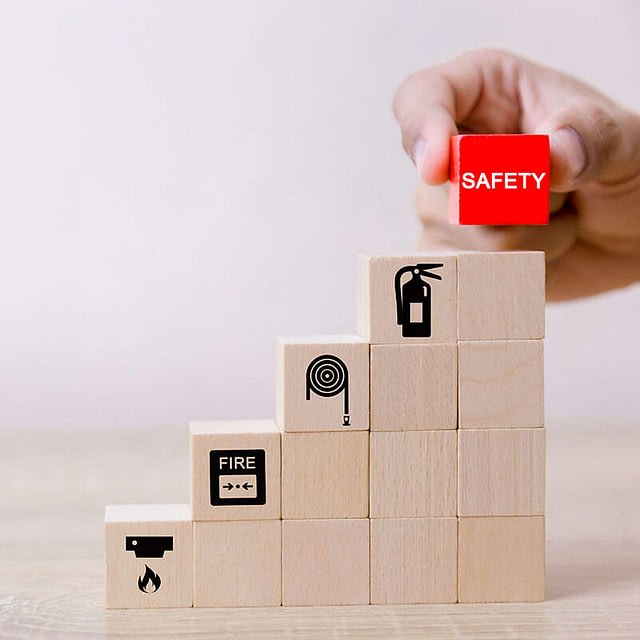
Fire Saefty Equipment from JLA

Key takeaways

  • Fire risk assessment determines which protection systems your business needs
  • Integrated solutions combining detection, suppression, and emergency systems provide comprehensive coverage
  • Professional installation and ongoing maintenance are essential for system effectiveness
  • Compliance with The Regulatory Reform (Fire Safety) Order 2005 is mandatory for UK businesses
  • Total Care contracts eliminate capital costs while ensuring expert maintenance and compliance
  • Industry-specific solutions address unique risks in hospitality, healthcare, and manufacturing sectors

Table of Contents

Understanding your business fire protection requirements

A complete fire protection solution integrates active and passive fire safety equipment to provide comprehensive coverage, protecting what matters most. Your solution might include detection, suppression, and emergency systems, all of which are aimed at reducing the potential for widespread damage from flame and smoke.

The question is, how do you decide on your business’ fire protection requirements? And what are the most common fire risks by business type?

Conducting a professional fire risk assessment (FRA)

A fire risk assessment (FRA) is the first step in deploying comprehensive fire protection measures for your business. Carried out by a fire safety specialist, this process identifies the most at-risk areas of your operations, so that the right equipment and processes can be deployed where they’re most needed.

New businesses may not be aware that carrying out a FRA is a legal requirement under the Regulatory Reform (Fire Safety) Order 2005. It falls to your business’s “Responsible Person” to arrange the FRA, with most enterprises opting for a third-party professional to undertake the work on their behalf.

As part of an FRA, fire safety inspectors will:

  • Identify potential fire hazards like dangerous substances and sources of ignition
  • Identify personnel and groups who may be at risk from fire, drawing up a detailed action plan
  • Work back from the worst-case scenario, implementing fire-safe equipment and protocols to mitigate damage and reduce risk
  • Draw up an emergency fire risk management plan that’s unique to your business. This will include recommended equipment, along with escape routes and evacuation plans

JLA provides commercial fire risk assessments, with our trained specialists able to provide guidance and advice on all aspects of fire protection and enhanced control measures.

Common fire risks by business type that may appear on your FRA

While the results of your FRA are unique to your business, there are certain hazards, risks, and pain points which fire safety inspectors will look out for depending on your company sector. Let’s take a look at some examples of common fire risks by business type.

Business type

Potential fire risk

Hotels & hospitality

From kitchen fires to guest evacuation routes – FRAs for hotels and hospitality venues are multifaceted and complex. Guest and staff safety is a priority for fire safety officials, with an emphasis on emergency lighting and comprehensive escape route planning.

Healthcare facilities

With reduced in-patient mobility, oxygen-rich environments, and the critical protection of life-saving equipment, healthcare facilities pose serious challenges for fire safety. 

Manufacturing centres

Fire risk assessors typically highlight chemical stores, overheating machinery, and flammable materials as the most at-risk areas of manufacturing centres.

Office buildings

Electrical equipment, paper storage, and evacuation routes are a priority in office environments. Of course, serviced office buildings containing multiple businesses present an even bigger challenge for fire safety officials.

Essential components of a complete fire protection solution

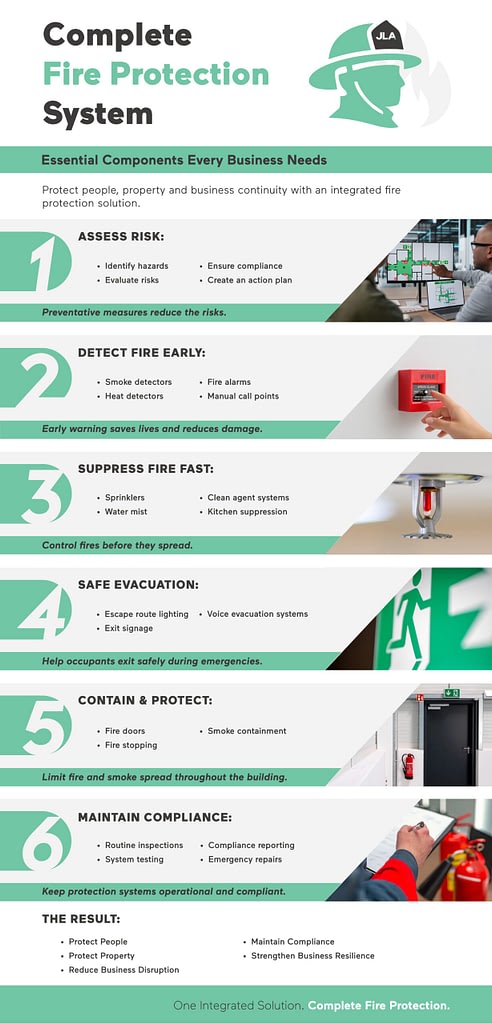
There’s no one-size-fits-all fire protection solution to suit every type of business, so your requirements may differ depending on your business and premises. However, there are similarities between the components that typically appear in a complete fire protection solution, including:

  1. Fire detection and alarm system
  2. Fire suppression system
  3. Emergency lighting and evacuation

These are the three core components that make up a full and complete commercial fire protection plan. Let’s take a closer look at each of these categories in turn.

Fire detection and alarm system

Early detection is the first line of defence against fire, making detection and alarm systems critical to your business’ fire protection solution.

Modern fire detection systems offer advanced early warning capabilities, including smoke detection, heat sensors, and automatic temperature monitoring. Such systems can also be controlled and monitored remotely, while also syncing directly with emergency services to instantly raise the alarm.

Fire suppression system

The next phase of fire protection involves suppressing flames and smoke. Suppression is a catch-all term for a variety of fire safety equipment used to tackle fires head-on, reducing how quickly they can spread to other areas of your business. 

Fire suppression has come a long way since the days of automatic room sprinklers (although these remain a useful tool as part of a wider solution). There are now a wide variety of flame and smoke control products to suit your business type, each offering unique benefits and characteristics. 

Let’s take a closer look at some of the typical suppression systems used as part of a commercial fire protection system.

Suppression type

Best for

Key advantage

Consideration

Sprinkler systems

General commercial premises

Proven, cost-effective, activates when heat is detected

Water damage to contents

Water mist systems

Heritage buildings, hotels, offices

Reduces water usage by 50–90% while suppressing fires effectively

Higher-pressure equipment required

Clean agent (HFC227ea / Novec 1230)

Server rooms, data centres, museums

HFC227ea systems use clean agent gas for sensitive equipment – no residue

Higher upfront and recharge costs

Kitchen suppression

Commercial kitchens

Rapidly suppresses grease fires on cooking equipment

Requires regular cleaning and inspection

Foam systems

Flammable liquid storage, fuel sites

Effective on flammable liquids

Environmental impact and cleanup considerations

Emergency lighting and evacuation

Escape route planning is a critical component in any fire protection solution, even in cases where there are very few staff onsite. As part of your business’ FRA, risk assessors will map out your premises and plan the safest evacuation routes, factoring in at-risk personnel, visitors, and guests.

Planned fire evacuation routes typically require the following:

  • Emergency escape lighting meeting BS5266 standards
  • Exit signs and wayfinding systems
  • Voice alarm systems for clear evacuation instructions
  • Evacuation alert systems for high-rise buildings

Your evacuation plan will be unique to your business, and must be managed, maintained, and overseen by the Responsible Person within compliant limits. In serviced commercial premises, coordination with onsite management teams is essential in clarifying evacuation plans and undertaking key exit routes.

Complete Fire Protection System

Key factors when choosing your fire protection system

While your fire protection system will be dictated largely by the results of your FRA, there are some key factors at play that will hold sway over the scope of your system and, ultimately, how much it’s likely to cost.

Building size and layout considerations

The size and layout of your premises will have a significant impact on the complexity of your fire protection solution, and the exact components and features required. 

That’s not to say that large premises will require more complex fire safety systems than smaller buildings by default. The presence of open-plan vs compartmentalised spaces can have a significant impact on the scope of your system, while ceiling heights, access routes, and the presence of integrated HVAC systems can also dictate the controls and components you’ll need.

Regulatory compliance requirements

There is a suite of regulatory compliance orders that your building must comply with to maintain legal fire protection status. Here’s a quick rundown of the current laws governing regulatory fire safety compliance in the UK, not all of which may apply depending on your location:

  • Regulatory Reform (Fire Safety) Order 2005 – primary fire-safety law in England & Wales.
  • Building Regulations 2010 – Approved Document B – fire safety in building design/construction.
  • Fire Safety Act 2021 – additional fire-safety duties, particularly for multi-occupied buildings.
  • Fire Safety (England) Regulations 2022 – specific requirements for residential buildings.
  • Scotland: Fire (Scotland) Act 2005.
  • Northern Ireland: Fire and Rescue Services (Northern Ireland) Order 2006.

Those are only the basic countrywide regulations that commercial premises will need to adhere to to maintain fire safety compliance. There may be other industry-specific standards and certifications at play in your sector, while insurance companies may require specific fire safety solutions as part of your ongoing policy, too.

Budget and financing options

A comprehensive fire protection solution is a non-negotiable fact of life for business owners. However, that doesn’t mean that such systems are free from purchase and maintenance costs, which you’ll need to factor into your short- and long-term operational budget.

If you’re concerned about the financial ramifications of installing a new fire protection solution, there are ways to offset the cost and avoid hefty upfront outlay. For instance, Total Care from JLA can be used to deploy new fire safety equipment, offering all-inclusive installation, servicing, and support, all for a fixed monthly fee.

It’s worth noting, too, that upgrading your current fire protection setup could actually save your business in other areas – chiefly its annual insurance premium. Vendors may offer a reduced renewal quote in light of recent fire safety upgrades, potentially offsetting at least some of the cost of new equipment.

Implementation and maintenance considerations

From installation and servicing to ongoing testing – your on-site fire protection solution will require total oversight and proactive maintenance to ensure it’s always working at its best. With that in mind, let’s take a look at the installation process, as well as the ongoing servicing requirements of your commercial fire safety solutions.

Outlining the professional installation process

Onboarding a new fire safety system happens in phases, each managed by your assigned fire protection partner. These phases include:

  • Phase 1: Site survey and detailed system design. Here, fire safety specialists will attend your premises, designing a bespoke solution that targets key hazard points identified as part of your FRA.
  • Phase 2: Coordinated installation, minimising business disruption. Your new fire protection solution will be installed at a time that suits you, avoiding peak business hours to mitigate potential disruption and downtime where possible.
  • Phase 3: Commissioning and testing. This is when your attending fire safety engineer will test the new system thoroughly, ensuring it’s fully operational and working as intended.
  • Phase 4: Staff training and handover documentation. This is the final part of your fire protection solution rollout, in which fire safety officials will liaise with you and your team to offer guidance on the new system. You’ll also receive the necessary certification to prove full compliance, which may be useful when dealing with insurers.

Ongoing maintenance and testing

To ensure that your fire protection solution remains fully compliant and in sound working order, it’ll need to be tested on a fixed schedule. 

Weekly alarm testing is recommended at a designated time each week, while a full monthly fire alarm and evacuation test is also required. You should also look to have your fire system tested annually by an accredited service engineer.

Selecting the right fire protection partner

It’s important to choose a competent, accredited, and reliable partner for your fire protection upgrades. Here are some attributes to look for when comparing different service providers:

  • BAFE certification and industry accreditations
  • NSI approval for security and fire systems
  • Evidence of manufacturer authorisations and training
  • 24/7 emergency response and repair services
  • National coverage and local support teams
  • Digital monitoring and remote diagnostics capabilities

Tip: Check your insurance policy for any reference to specific protection partner requirements. You may be required to work with fire safety specialists with BAFE certification and other industry accreditations, so the third-party provider must meet these requirements so as not to invalidate your policy.

 FAQs

What components make up a complete fire protection solution?

A fire protection solution incorporates detection, suppression, and evacuation equipment. That includes everything from emergency lighting and fire extinguishers to a fire alarm control panel (FACP).

How much does a complete fire protection system cost for a typical business?

It’s difficult to put an average figure on the cost of a fire protection system, as this can vary significantly depending on the size and layout of the premises, the complexity of the system, and the specific risks it’s safeguarding against.

How often do fire protection systems need maintenance and testing?

Fire systems should be tested weekly by the Responsible Person in your business. Further testing and maintenance should be performed monthly, with a professional service performed at least once a year by a fire safety practitioner.

Can I finance fire protection equipment instead of purchasing outright?

Absolutely! For example, JLA Total Care can be used to finance new fire protection equipment for a fixed monthly cost with no initial outlay. 

How long does it take to install a complete fire protection system?

That depends on the complexity of the work involved and the scope of the system. Rest assured that fire-safe engineers will work as quickly as possible to ensure that the installation doesn’t result in unexpected downtime and delays.

Investing in a new fire protection solution for your business is always money well spent. If you’re looking to upgrade your on-site fire safety provisions, JLA can help. We can assess, install, and maintain fire protection solutions on your premises, and offer a mix of accreditations from industry bodies. Get help today by calling 0808 239 7578.

Picture of Mark Bone
Mark Bone

Operations Director Mark joined JLA in 2019 and now manages the delivery of turnkey fire safety and security systems designed to protect people, premises and critical assets.

Drawing on his extensive technical, commercial and customer service experience, Mark helps clients with everything from system selection and project planning to ongoing maintenance, ensuring they can navigate complex operating challenges.

In a shifting regulatory landscape, Mark also provides a wealth of safety-first guidance, with a particular focus on reducing risk and strengthening compliance across every site.

George Barclay
  • George Barclay
  • Laundry Expert

A hotel’s laundry operations have the potential to make or break the long-term success of your business, tied as they are to the overall guest experience. As such, reliable processes are essential in maintaining tight control and reducing operational pain points.

Join us for a closer look at the common stress factors that hotel laundry rooms face, including equipment breakdowns and staff shortages. We’ll offer practical solutions on how to cope with these issues, while comparing in-house vs outsourced laundry provisions. Plus, our experts are on hand with some essential tips for hotel laundry managers.

Clean and ironed linen

Key challenges at a glance

  • Consistent linen supply prevents last-minute scrambling during peak occupancy periods
  • Professional laundry partnerships eliminate equipment maintenance headaches and downtime costs
  • Streamlined operations allow management to focus on revenue-generating guest services
  • Quality control systems reduce guest complaints and negative reviews
  • Predictable costs and scheduling improve budget planning and staff allocation
  • Emergency backup systems ensure business continuity during unexpected challenges

Table of Contents

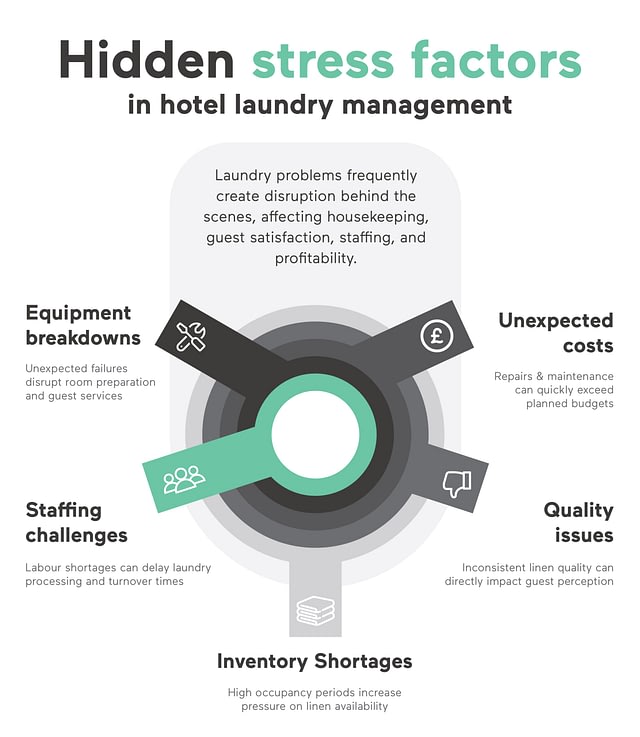
The hidden stress factors in hotel laundry management

Managing a laundry room is among the most challenging aspects of running a hotel. In no other sector does an efficient laundering process carry more weight; get it right and you’ll quickly establish a solid reputation among guests; get it wrong, and you could be at the mercy of a throng of negative reviews and poor customer feedback.

Of course, there’s more to consider besides guest experience, even if this is a chief priority. Operating costs, long-term efficiency, and general business growth are all tied up in your laundry room, too.

That brings us sharply to the key stress factors that can plague hotel laundry operations if left unresolved. These are the kind of problems that you may never have considered, but which could have a detrimental impact on the day-to-day running and efficiency of your laundry room.

  • Equipment breakdowns during peak season causing guest service disruptions
  • Staff shortages in laundry departments affecting room turnover times
  • Quality inconsistencies leading to guest complaints and reputation damage
  • Unexpected maintenance costs impacting monthly budgets
  • Linen inventory shortages during high occupancy periods

The ripple effect of hotel laundry room problems

Should any of these problems arise in your laundry suite, the effects may be felt in other areas of your business – and never in a good way. Let’s take a closer look at some of the potential consequences of laundry room inefficiencies.

Housekeeping delays and problems at check-in

Bottlenecks impacting your laundry throughput will almost certainly trickle down into housekeeping, causing delays with the turnover of guest rooms. This, in turn, creates a check-in backlog – not a good first impression for those visiting your establishment.

Inconsistent laundry quality leading to a negative guest experience

If your laundry team is constantly on the back foot, this will make it much harder to guarantee consistent results. If linens and towels are poorly laundered, this could contribute to a negative experience for your guests.

Revenue loss from delayed room turnovers and service failures

It’s not beyond the realm of possibility that failures in your laundry room could contribute to lost revenue. For instance, reimbursing guests for missed check-in windows or requiring staff to work additional overtime could easily impact your bottom line in the long term.

The hidden stress factors in hotel laundry management

How reliable systems eliminate daily operational headaches

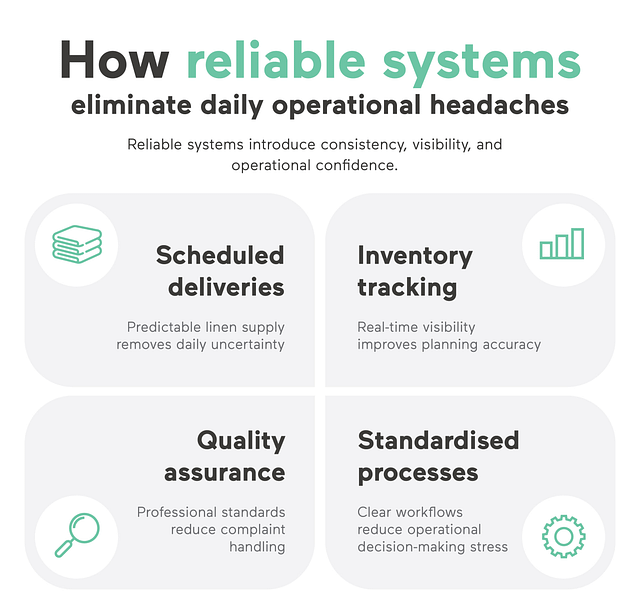
Building reliable and consistent systems into your laundry process is one of the best ways to eliminate daily operational headaches and safeguard against laundry room stress factors. 

Here are some of the ways you can build resilience into your laundry process with reliable systems and effective management.

The importance of capacity in your hotel laundry room

It’s impossible to build a time-efficient laundry process that you can rely on day after day without commercial laundry equipment that’s the right capacity for your business.

If your team is reliant on outdated or at-capacity washing machines and tumble dryers, they’ll constantly be under the cosh, trying their hardest to hit unreasonable deadlines. Not only could this directly affect consistency and results (not to mention staff morale), but it leaves no headroom for increased demand during busy periods.

Be sure to review your on-site laundry equipment regularly to make sure it remains the most practical solution to cope with daily demand. 

Establish a reliable QA system for fresh linens and towels

First impressions count in the hotel trade more than in any other sector. From the moment a guest enters your premises, they’ll be appraising your offering – from the friendliness of your reception staff to the quality of linens and towels in their room.

On this second point, it’s well worth establishing a consistent QA system to bookend your laundry process, ensuring that no unsatisfactory bed linens or towels are ever exposed to guests. Sure, it takes time to check over individual items in the post-laundry cycle, but it’s worth factoring this into your schedule to maintain exceptional results.

Have a contingency plan for peak demand periods

As alluded to earlier, one of the key stress factors for hotel laundry rooms is sudden peaks in demand. This can leave your laundry teams on the back foot, scrambling to cope with increased throughput and jeopardising guest experience delivery as a result.

This illustrates just how important it is that different departments within your business have open lines of communication. Should booking managers notice a spike in demand, make sure this information is passed down the chain so that everyone is prepared; of course, automated systems can help with this, too.

In your laundry room specifically, have provisions in place for peak-demand periods. For instance, arrange for overtime working with key staff or greenlight the use of third-party laundry services to help pick up the slack when onsite teams can’t cope with immediate demand. Of course, a chain of command is essential here, so delegate effectively.

How reliable systems eliminate daily operational headaches

Technology solutions for stress-free laundry operations

Based on our experience of working alongside UK hotels both big and small, we’ve encountered a variety of technology solutions that prove real difference-makers when used alongside high-performance laundry equipment.

Let’s take a closer look at some of the systems and tech that your laundry teams may like to take advantage of for improved process automation and stress-free laundry operations.

RFID tracking system

A radio frequency identification (RFID) system is one of the most reliable ways of keeping tabs on the process of individual items through your laundry suite. Not only does it show where an item is in the chain, but it also counts the number of cycles a single item has been through – so you know when to update and renew.

Automated reorder system

Let’s say towels or bed linens have hit a certain number of cycles according to your RFID; an automated reordering system replenishes these with no manual input required, helping you maintain the standards your guests expect.

Digital reporting tools

Digital reporting tools afford maximum oversight of your laundry suite. You can use such tools to monitor individual cycles or get a bigger picture of your overall laundry room efficiency, so you can easily identify areas for improvement.

Mobile monitoring apps

You might feel like you can’t be in all places at once when managing your hotel, which is why mobile monitoring apps are so useful. Systems like JLA Connect offer remote monitoring across your laundry room, so you can track cycle data and get fault alerts all in one place.

In-house vs outsourced hotel laundry operations: Key pros and cons

It’s not uncommon for hotels to outsource their laundry operations, particularly if they don’t have the space, the staff, or the resources to handle laundering on site. Of course, there are pros and cons to this, so we thought it would be useful to take a look at both in-house and outsourced laundries in an attempt to figure out which is best for reducing operational stress.

Factor

In-house laundry 

Outsourced laundry

Control

High control over washing, drying, and finishing

Less direct control

Initial investment

High – equipment, installation and infrastructure (although solutions like Total Care can help)

Low – no large laundry installation required

Labour

Requires trained laundry staff

Staffing largely handled by supplier

Running costs

Utilities, chemicals, maintenance and labour

Regular service/processing charges

Capacity

Limited by on-site equipment and staffing

Can often scale with hotel demand

Turnaround

Potentially very fast

Dependent on collection/delivery schedule

Quality control

Directly managed by hotel

Depends on supplier’s processes

Equipment maintenance

Hotel’s responsibility

Normally supplier’s responsibility

Space

Requires dedicated laundry area

Frees up valuable hotel space

Inventory control

Hotel manages its own linen

Often supported by supplier systems

Flexibility

Can respond immediately to changing requirements

Changes may require coordination

Long-term economics

Can be economical at high volumes

Often attractive for smaller hotels

Key takeaways and top tips for hotel laundry management

Before we wrap up our guide on the practical ways to reduce operational stress in hotel laundries, here are some essential top tips and takeaways that could help you to rethink your current processes.

Tip #1: Have emergency response protocols in place

If laundry equipment fails or your team is taken by surprise by a sudden peak in demand, you need a contingency plan. The simplest and most effective solution is to have a third-party laundry provider that you can rely on in moments of crisis; establish this relationship ahead of time for complete peace of mind.

Tip #2: Lean on digital management and monitoring tools

The evolution of commercial laundry equipment over the past decade or so has led to the development of some truly groundbreaking solutions, chief among which are digital management and monitoring tools. Having the ability to track your laundry throughput remotely is invaluable for busy hotel managers, while improved reporting and automation can free up your teams to focus on the work that really matters.

Tip #3: Prioritise the guest experience

It might go without saying, but prioritising the guest experience is the single most important aspect of running a successful hotel laundry room. Sure, cost and efficiency savings are always nice-to-haves, but guest experience is the main attribute to safeguard – particularly given the detrimental impact that negative ratings can have on your business in the long term.

 FAQs

What are the main stress factors hotel managers face with laundry operations?

Equipment downtime, staff shortages, unexpected maintenance and servicing costs, and quality inconsistencies affecting guest experience are the main stress factors that can have a detrimental impact on a hotel laundry room.

How does outsourcing laundry reduce daily management workload?

Outsourcing to a trusted laundry specialist is an option for hotels, particularly during peak demand periods. It essentially allows you to scale up your laundering capabilities and can be extremely useful in emergencies (like equipment issues during busy periods, for example.

What technology features should hotels look for in laundry partnerships?

RFID, digital reporting, and mobile monitoring are some of the features that laundry partners can offer, providing total oversight and tighter control.

How do reliable laundry operations improve staff productivity?

Free from the burden of unnecessary manual processes, staff can focus on more important tasks, optimising key processes that can bring long-term efficiency. 

How does predictable laundry cost structure help hotel budgeting?

It helps enormously, particularly when unexpected maintenance, repair, and servicing costs are taken out of the equation. For instance, solutions like JLA Total Care offer an all-inclusive cost structure, with hotels paying a single monthly fee for new equipment, installation, servicing, and on-demand support.

We hope this resource has shone a light on the common stress factors that can plague hotel laundry rooms, and solutions to deal with them effectively. If you need help improving your on-site laundry capabilities, our experts are on hand to help. Call us today on 0808 239 7578 to discuss your requirements.

  • Giovanna Eaton
  • Compliance expert

Gas Safety Week is back for 2026, with the annual event scheduled to run from 14th-20th September. The theme for this year’s event is “Take No Chances”, which reinforces the message that there’s no second-chance saloon where gas safety is concerned.

Join our specialists for a closer look at Gas Safety Week 2026, as we highlight the importance of an effective commercial gas safety strategy. We’ll look at the practical steps you can take to improve the safety of your gas appliances, along with the most common faults and violations that affect a surprising number of businesses across the UK.

Fire Saefty Equipment from JLA

Key takeaways

  • Annual campaign runs Monday 14 September to Sunday 20 September 2026
  • Only Gas Safe registered engineers can legally work on commercial gas appliances
  • Commercial landlords face legal requirements for annual gas safety certificates
  • Carbon monoxide poisoning causes approximately 50 deaths annually in the UK
  • Regular maintenance reduces gas appliance breakdown risk by up to 80%

Table of Contents

What is Gas Safety Week September 2026?

Initially launched way back in 2011, Gas Safety Week empowers businesses and individuals to take a fresh approach to gas safety. Whether that’s performing additional safety checks, understanding the risks posed by gas-powered equipment, or enforcing the importance of gas-monitoring equipment in commercial premises – the event is a time to reflect on the risks posed by unsafe gas appliances.

If you’d like to learn more about Gas Safety Week 2026, along with practical tips and guidance on how to get involved, be sure to check out the Gas Safe Register website.

Why gas safety matters for commercial businesses

From commercial cooker hobs to HVAC components like boilers and hybrid heating systems – gas plays a vital role in the UK commercial sector. But with a business to run and customers to attend to, when was the last time you considered the safety of gas appliances on your premises?

During day-to-day operations, gas safety is easy to overlook. It may be that you’ve put off having an appliance serviced during a busy trading period, or simply that equipment has developed a small fault that so far has gone undiagnosed. 

Either way, unsafe gas appliances pose a significant risk to your business, as well as its people, clients and customers. 

Let’s explore some of the facts and statistics associated with faulty, damaged or poorly maintained gas-powered commercial equipment…

  • It’s estimated that around 16% of commercial catering premises in the UK feature unsafe gas appliances. Could your kitchen be one of them?
  • According to the latest figures, only 50% of commercial premises are broadly compliant with current gas safety legislation. 
  • Gas Safe Register investigations in 2020–21 identified 3,168 defects classed as At Risk (AR) or Immediately Dangerous (ID). 37% were attributed to registered businesses and 63% to unregistered fitters.
  • HSE says around seven people die each year on commercial premises from carbon monoxide poisoning caused by gas appliances and flues that have not been properly installed, maintained or adequately ventilated.
  • It’s thought that regular maintenance reduces gas appliance breakdown risk by up to 80% – highlighting the need for increased servicing and timely fault diagnostics.
Gas Safety Week September 2026: Essential Guide for Commercial Businesses

What are the legal requirements for commercial gas safety?

Commercial gas appliances must comply with Gas Safety (Installation and Use) Regulations 1998 (GSIUR), the primary gas safety legislation for England, Scotland and Wales. That’s on top of additional health and safety legislation, including the Health and Safety at Work Act 1974.

The primary takeaways of the GSIUR are as follows:

  • All work on commercial equipment must be undertaken by a Gas Safe registered engineer.
  • Gas appliances must be professionally installed, maintained and serviced on commercial premises. It’s not possible to service or maintain gas-powered equipment yourself.
  • Regular inspections are required to minimise the risk of leaks, damage, and premature wear and tear. 
  • Adequate ventilation is required, including the installation of new flues and extractor units to make safe areas where gas appliances are in use.
  • Safety devices like carbon monoxide alarms must always be used in close proximity to gas-powered commercial equipment.
  • Businesses should maintain appropriate records of inspections, servicing, repairs and defects.

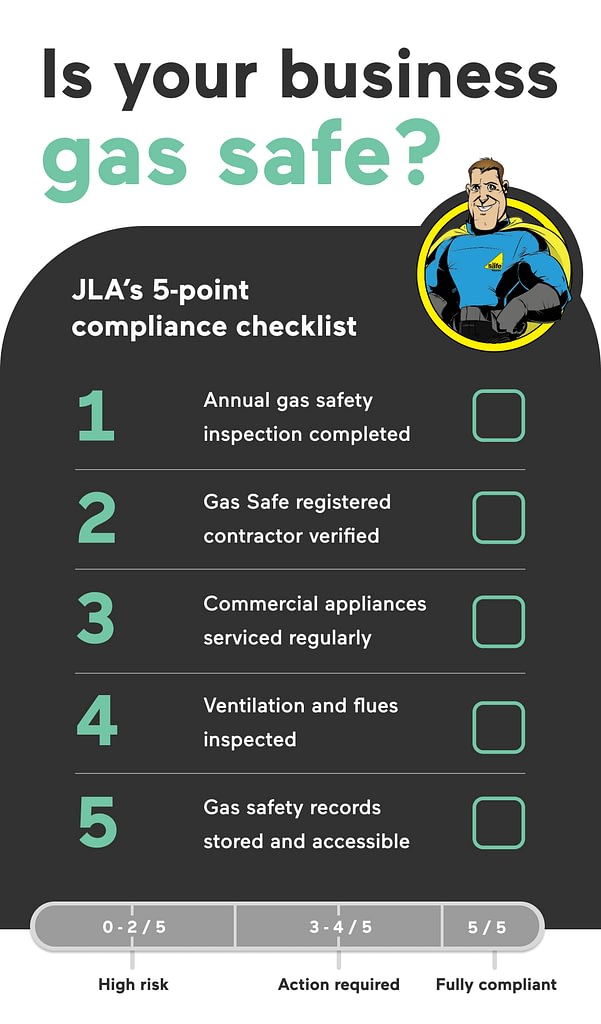
Essential gas safety checks for commercial properties

In light of Gas Safety Week 2026, not to mention the approaching autumn/winter season (when gas is more widely used), now is the ideal time to carry out essential gas safety checks on your premises. So, here’s a checklist of inspections to add to your to-do list – or else to delegate to a trusted Gas Safety engineer during a planned maintenance visit.

Daily visual inspections

Get in the habit of checking gas appliances whenever you use them. From the condition of a pilot light to the presence of lingering odours – there are several tell-tale signs that equipment may be faulty or in need of servicing, so it’s important to remain vigilant and make routine checks a part of your daily equipment workflow.

Professional annual inspections

Perhaps Gas Safety Week 2026 is the ideal opportunity to book a service and inspection with a Gas Safe registered engineer? If it’s been 12 months since your equipment was last checked and tested, you’re legally required to schedule a maintenance inspection with an accredited engineer. 

Did you know that JLA offers professional gas safety checks? Our Gas Safe registered engineers can test, inspect, service, and maintain all commercial gas equipment on your premises, so why not get a quote and book your next inspection with our specialist team?

Creating a gas safety action plan

If nothing else, Gas Safety Week 2026 puts the importance of gas safety in the spotlight, and that can only be a good thing. Indeed, we’d say it’s the perfect time to reframe how you approach equipment safety on your premises, and the opportune moment to create a gas safety action plan.

Immediate actions for Gas Safety Week

There are things you can do this Gas Safety Week to improve gas safety on your commercial premises. For example…

  • Book an inspection of your gas appliances with a Gas Safe registered engineer
  • Verify that your current maintenance contractors and third-party suppliers are Gas Safe registered
  • Review and update emergency evacuation procedures for gas incidents
  • Schedule outstanding annual safety inspections before year-end
  • Hold a staff briefing on gas smell recognition and emergency contact procedures

Building a long-term gas safety strategy

Gas Safety Week isn’t designed as a flash-in-the-pan initiative. It’s a chance to reframe your long-term approach to gas safety on your premises, implementing strategies and changes that will ensure consistent compliance and safety moving forward.

With that in mind, consider adding these measures to your long-term gas safe action plan…

  • Improve how you report and document changes to gas-powered equipment. This ensures optimal compliance, improved traceability, and more effective long-term fault monitoring.
  • Establish fixed servicing, inspection, and maintenance intervals with a Gas Safe registered engineer. 
  • Develop a more comprehensive staff training plan around gas safety. 
  • Budget for equipment upgrades and improvements that will improve your business’s gas safety infrastructure.

Common gas safety violations in commercial properties

Gas safety violations follow a similar pattern in commercial properties. Typically, they stem from poor ventilation, inadequate maintenance and servicing, damaged pipework or connections, and improper installation. 

Let’s take a closer look at some of the most common issues that can crop up on commercial premises gas safety inspections.


Issue

Why it’s a problem

Potential consequences

Inadequate maintenance

Poorly maintained and serviced gas equipment is more liable to develop faults, which could have disastrous consequences.

Gas leaks, fires, CO poisoning, and even explosions may occur.

Inadequate ventilation

Blocked or poorly maintained ventilation systems can have a knock-on effect on gas appliances, significantly increasing the risk. 

Hazardous CO accumulation, poor or reduced equipment performance, and a significant risk of fire.

Damaged pipework and connections

During day-to-day operation, it’s easy for gas pipework to become damaged, corroded, or snagged, posing a major risk to gas safety.

Gas leaks may occur, with a significant risk of fire. There may also be an accumulation of CO, with long-term effects for staff.

Improper installation

Not only does improper installation pose a risk to gas safety, but it could also mean that your business isn’t compliant with GSIUR.

Significant risk from gas leaks, along with the legal ramifications associated with non-compliance.

 FAQs

What gas safety checks are legally required for commercial properties?

Gas safety checks must be completed in line with GSIUR legislation. Typically, this means having all gas-powered appliances inspected by a Gas Safe registered engineer at least once a year.

How often must commercial gas appliances be inspected by Gas Safe engineers?

Commercial gas appliances must be inspected at least once every 12 months by a Gas Safe registered engineer. You may wish to increase this interval where gas appliances are heavily used, however.

What should I do if I smell gas in my commercial building?

If you can smell gas, immediately stop what you’re doing and call the National Gas Emergency Service on 0800 111 999.

In the meantime, if it’s safe to do so, ventilate the space, switch off all equipment, and evacuate the premises.

Who can legally carry out gas work on commercial catering equipment?

Only a Gas Safe registered engineer can carry out work on commercial gas appliances, including catering equipment. Never carry out work yourself, and always check the credentials of suppliers before permitting them to service, inspect, or maintain your equipment.

What are the penalties for non-compliance with commercial gas safety regulations?

In commercial properties, non-compliance with gas safety regulations could result in enforcement notices, prosecution and substantial fines. In light of the most serious offences, you may even face imprisonment.

With Gas Safety Week 2026 right around the corner, now is the perfect time to take a moment to consider your business’s gas safety strategy. Remember, if you need any help with inspections, maintenance, or equipment upgrades, the expert Gas Safety registered specialists at JLA are here to help. Call us today on 0808 239 7578 and we’ll take care of it.

  • Giovanna Eaton
  • Compliance expert

A commercial kitchen degreaser is the ultimate tool for tackling grease, grime, and burnt-on food in your catering business. But which type of professional degreaser will work best in your kitchen? This guide can help you decide.

Here, we’re taking a look at the four main types of commercial kitchen degreasers, including water-based, solvent-based, foaming, and enzymatic products. We’ll also share some tips on sourcing the best cleaners for your professional kitchen, as well as advice on how to use degreasers safely and effectively to maintain peak levels of food safety, hygiene, and cleanliness.

Catering hygiene

Key takeaways

  • Commercial kitchen degreasers are mandatory for food safety compliance and health regulations
  • There are four main types available: water-based, solvent-based, foaming, and enzymatic degreasers
  • Proper degreaser selection depends on surface type, grease level, and cleaning frequency
  • Regular degreasing prevents fire hazards and maintains equipment longevity
  • Professional application methods ensure maximum effectiveness and safety

Table of Contents

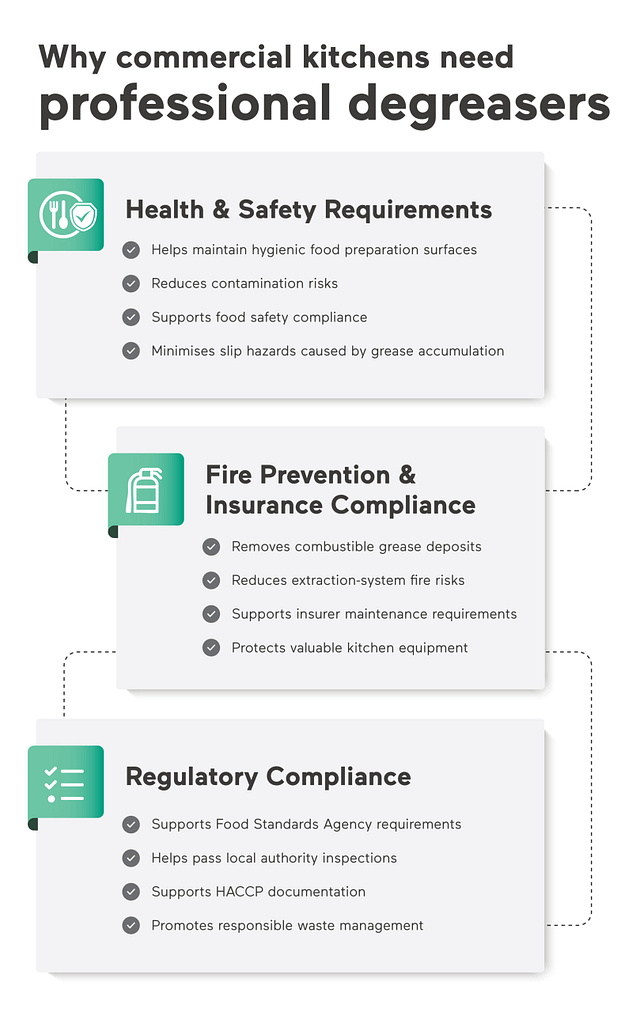
Why commercial kitchens need professional degreasers

If you’re new to the catering industry or taking your first steps towards opening a commercial kitchen, you may be wondering what the big deal is around commercial-grade degreasers. After all, surely any old cleaning product would do the job just fine, right?

Wrong. Not only are commercial kitchen degreasers specially formulated to eliminate harmful grease and grime, but using them is tied to general food safety and hygiene in the kitchen. They play a key role in fire prevention, too, making them pretty indispensable. 

Let’s take a closer look at the why of using kitchen degreasers in your commercial kitchen.

Health and safety requirements

Although using a professional degreaser isn’t a legal requirement, keeping your kitchen clean is. And since commercial-grade degreasing products are among the best in the biz for cleaning up dirt, grime, and burnt-on debris, it makes sense to use them as part of your daily cleaning workflow.

The UK Food Standards Agency has a variety of health and safety rules in place to ensure that professional kitchens and catering businesses keep work areas hygienic and spotlessly clean. Part of this involves effectively removing grease and food residues, so what better to use than a degreasing product?

Health and safety inspectors will want to see evidence that your kitchen is clean and free from dirt, grease, and grime, all of which can attract bacterial growth if left unchecked. They’ll review your arsenal of cleaning products while quizzing you on your daily cleaning routine, so you’ll need to be prepared and have the right products to hand.

Fire prevention and insurance compliance

Did you know that regularly using a commercial-grade kitchen degreaser is one of the most effective ways to prevent fire? This makes sense when you consider how flammable many greasy substances are, particularly if they’re present near commercial ovens and open-flame hobs.

Not only that, but airborne grease, dirt, and grime can easily coat other surfaces too, including those connected to your broader HVAC system; extractor fans, for example. This can present its own fire and smoke-related hazards, so using a professional degreaser on such components is critical in early prevention.

Note, too, that your insurance company will require you to clean your kitchen in line with current H&S best practices. Some policies may even include wording around the specific products they expect you to use to maintain peak cover; failure to do so could void your policy and leave you in dire straits should the worst happen.

Types of commercial kitchen degreasers

There are four types of commercial kitchen degreasers that you can use to tackle grease and grime on your premises. We recommend using a combination to ensure effective cleaning on different substances, as some products may be better suited to different applications than others.

With that said, let’s introduce you to the four degreaser categories, showcasing their characteristics and examples of where they can be used effectively.

Water-based degreaser

What is it?

A general kitchen degreaser that can be used on a variety of messes. Water-based degreasers typically contain surfactants which break down greasy residue on contact.

Benefits

Easy to work with, water-based degreasers are perfect for everyday cleaning and produce a low odour.

Drawbacks

Some water-based degreasers may not be 100% effective on all greasy residues.

Solvent-based degreaser

What is it?

Solvent-based degreasers are used for heavy-duty cleaning. They contain organic solvents which penetrate and break down oily material.

Benefits

Solvent degreasers are perfect for use on stubborn dirt and grime, powering through the toughest stains and marks.

Drawbacks

These products can be hazardous and require full PPE; many also produce strong odours.

Foaming degreaser

What is it?

Foaming degreasers are exactly what they sound like: cleaning products that produce foam. This makes them great for cleaning hard-to-reach areas and dissolving stubborn grime.

Benefits

Foaming degreasers produce a layer of foam that actively dissolves grease and grime on contact, even in hard-to-reach areas.

Drawbacks

Be aware of the manufacturer-recommended “contact time” – the safe time frame for leaving foaming degreasers to do their thing.

Enzymatic degreaser

What is it?

Enzymatic degreasers offer the cleaning power of solvent-based products without the strong odour and harsh chemicals. They contain enzymes that break down grease and fatty residues.

Benefits

Enzyme-containing degreasers are great for food preparation areas, since they contain few harsh chemicals while powering through tough grime.

Drawbacks

The efficacy of these cleaners can be affected by different factors, including water temperature and pH levels.

Choosing the right degreaser for your kitchen

Familiarising yourself with the various different types of kitchen degreaser is one thing – knowing which one you need is another. 

While we generally recommend using a combination of different cleaning products depending on the application, it’s true that some degreasers may be better suited to your professional kitchen than others. So, here are some hints and tips on how to select the right kitchen degreaser for your catering business.

Consider your day-to-day cooking methods

The amount of grease and grime your kitchen produces will largely hinge on the type of food you prepare along with the commercial catering equipment you use to produce it.

For instance, if you regularly use deep-fat fryers and similar cooking appliances, you’ll certainly be at higher risk of grease build-up. And that includes on general food prep surfaces as well as in your extractor system. As such, you may require a heavy-duty degreaser that can easily handle oily and fatty residues. 

Cleaning processes and schedule

Different kitchens have different cleaning routines, based largely on their day-to-day service schedule as well as staffing levels. 

For instance, some caterers may take a clean-as-they-go approach, with assistants responsible for keeping surfaces clean and grime-free during a busy kitchen service period. Meanwhile, others may only have the resources available for end-of-day cleaning.

Naturally, this could affect the type of cleaning products you use. For general cleaning throughout the day, a water-based degreaser may be sufficient to maintain peak cleanliness; for end-of-day cleaning, a foaming, solvent-based, or enzymatic degreaser may be required to cut through build-up, burnt-on food, and stubborn grime.

Surface compatibility

Before you start using a commercial-grade kitchen degreaser, you must test it on an inconspicuous area. Some degreasers – particularly those containing powerful cleaning solvents – may not be suitable for all kitchen surfaces and food preparation areas, so this could ultimately dictate the type of products that are safe to use in your commercial kitchen.

Best practices for degreaser application

Applying degreasers may seem self-explanatory, but it’s important to follow manufacturer guidance and general H&S best practices to ensure optimal results. With that in mind, let’s take a closer look at the how of using professional degreasers in your commercial kitchen.

Safety procedures

Before you even think of squirting any degreaser around your kitchen, there are some H&S procedures you’ll need to take care of to ensure safe and effective cleaning. These include:

Wearing the appropriate PPE: Rubber gloves are non-negotiable, while eye protection and face masks may be required when using strong solvent-based cleaners.
Adequate ventilation: Where possible, open windows and switch on extractor fans to allow maximum ventilation and airflow when using chemical degreasers, particularly if they produce bad odours.
Chemical handling and storage: Always read the label to understand how to safely store chemical cleaners in your commercial kitchen. Careful handling is essential, too.
Emergency procedures and first aid: Ensure you have protocols in place to deal with chemical burns and splashes; a watch station and first aid is essential when using these products.

Application techniques

You’ll get better results with less effort if you use professional degreasers as the manufacturer intended. Here are some essential tips to steer you in the right direction:

Shut down equipment where necessary: For instance, any heat-producing appliances, like stoves and hobs, may need to be shut down and disconnected when using specific degreasing products.
Ensure correct dilution and mixing: Read the product label to ascertain whether you need to dilute or mix the cleaner prior to use. This may be necessary on certain surfaces, so always check before you apply.
Consider the contact time for maximum efficacy: While it may be possible to spray on and wipe off in some instances, some degreasers work best when left to work for a few minutes, particularly on stubborn grime and burnt-on debris. Check the product information carefully and stick to the recommended contact times.
Rinsing and sanitisation: It’s critical that you remove any leftover residue after using a kitchen degreaser, potentially with another chemical-safe sanitising product. Rinse thoroughly for clean, perfectly sanitised results.

 FAQs

How often should commercial kitchens be degreased?

That depends on the type of food you prepare, the cooking appliances you use, and how busy your service periods are. Generally, it’s recommended that professional kitchens are degreased at least once a day to prevent the build-up of stubborn grease, grime, and burnt-on food, while maintaining compliant food hygiene and cleanliness standards.

What's the difference between degreasing and regular cleaning?

Degreasing means using products specifically designed to break down oily substances, fats, and other grease-forming substances. You can use general surfactants and cleaners instead, but these might not be sufficient to prevent build-up and remove the most stubborn deposits.

Are enzymatic degreasers safe for food-contact surfaces?

Yes, some enzymatic degreasers can be safely used on food-contact surfaces. However, not all products are suitable for this application, so choose products wisely.

How do I dispose of used degreaser solutions properly?

Check the product’s Safety Data Sheet (SDS), particularly Section 13, which covers “Disposal considerations”. Never dispose of degreasing solutions in a surface water drain; instead, collect them in a compatible container and dispose of them via an authorised chemical waste disposal unit.

Can I use household degreasers in a commercial kitchen?

That’s possible, but you may not get the best results. Household degreasers aren’t formulated to the same standard as their professional counterparts, so you may need to use more product and more elbow grease to achieve the same results.

What training do staff need for safe degreaser use?

Make sure that staff are up to speed on the PPE requirements when using strong kitchen cleaners like degreaser solutions. You’ll need to train them in correct chemical handling, storage, and disposal, too, as well as highlighting usage tips like optimal contact time and dilution.

We hope this comprehensive resource has helped you get to grips with professional kitchen degreasers and where, why, and how they can be used in your catering business. JLA stocks a variety of professional kitchen cleaners and degreasers, and we can advise you on the right products you need for the job. Call us on 0808 239 7578, and we’ll be happy to help.

Recent Posts

  • How to Choose a Complete Fire Protection Solution for Your Business in 2026
  • How Reliable Laundry Operations Reduce Operational Stress for Hotel Management
  • Gas Safety Week September 2026: Essential Guide for Commercial Businesses
  • The Complete Commercial Kitchen Degreasers Guide: Types, Benefits & Best Practices
  • Clear Signs Your Hotel Has Outgrown Its Current Laundry Setup

Recent Comments

    Archives

    • September 2026
    • August 2026
    • July 2026
    • June 2026
    • May 2026
    • April 2026
    • March 2026
    • February 2026
    • January 2026
    • December 2025
    • November 2025
    • October 2025
    • September 2025
    • August 2025
    • July 2025
    • June 2025
    • May 2025
    • April 2025
    • March 2025
    • February 2025
    • January 2025
    • December 2024
    • November 2024
    • October 2024
    • September 2024
    • August 2024
    • July 2024
    • June 2024
    • May 2024
    • April 2024
    • March 2024
    • February 2024
    • January 2024
    • December 2023
    • November 2023
    • October 2023
    • September 2023
    • August 2023
    • July 2023
    • June 2023
    • May 2023
    • April 2023
    • March 2023
    • February 2023
    • January 2023
    • November 2022
    • October 2022
    • September 2022
    • July 2022
    • June 2022
    • May 2022
    • April 2022
    • March 2022
    • December 2021
    • April 2021
    • February 2021
    • January 2021
    • December 2020
    • November 2020
    • October 2020
    • September 2020
    • August 2020
    • July 2020
    • June 2020
    • May 2020
    • February 2020
    • November 2019
    • October 2019
    • September 2019
    • July 2019
    • May 2019
    • April 2019
    • March 2019
    • January 2019
    • September 2018
    • May 2018
    • October 2017
    • August 2017
    • May 2017
    • April 2017
    • March 2017
    • August 2016
    • May 2016
    • March 2016
    • February 2016
    • August 2015
    • July 2015
    • June 2015
    • May 2015
    • March 2015
    • January 2015
    • November 2014
    • May 2014

    Categories

    • Catering
    • Energy saving
    • Fire safety
    • General
    • HVAC
    • Hygiene
    • Laundry
    • Testimonials

    Meta

    • Log in
    • Entries feed
    • Comments feed
    • WordPress.org
    Need help? Call us on

    01422822282

    Facebook Linkedin
    PQAL & Black on White UKAS 27001 Logo
    Cyber Essentials Plus Certified
    About JLA
    • Who we are
    • Careers
    • ESG at JLA
    • Accreditations
    • Blog
    • Total Care from JLA
    • Testimonials
    • Who we are
    • Careers
    • ESG at JLA
    • Accreditations
    • Blog
    • Total Care from JLA
    • Testimonials
    Solutions
    • Commercial laundry equipment
    • Catering equipment
    • HVAC
    • Fire safety
    • Infection Control
    • Commercial laundry equipment
    • Catering equipment
    • HVAC
    • Fire safety
    • Infection Control
    Sectors
    • Care Homes
    • NHS & Healthcare
    • Health clubs
    • Holiday parks
    • Hospitality
    • Hotels & spas
    • Housing
    • Facilities management
    • Football clubs
    • Pubs & restaurants
    • Equine and Stables
    • Vets & animal care
    • More sectors
    • Care Homes
    • NHS & Healthcare
    • Health clubs
    • Holiday parks
    • Hospitality
    • Hotels & spas
    • Housing
    • Facilities management
    • Football clubs
    • Pubs & restaurants
    • Equine and Stables
    • Vets & animal care
    • More sectors
    • Privacy & cookies
    • Terms & conditions
    • Modern slavery
    • Covid-19
    • Responsibility
    • Site map
    • Privacy & cookies
    • Terms & conditions
    • Modern slavery
    • Covid-19
    • Responsibility
    • Site map

    Get my quote

    By clicking Get my quote, you agree to the Terms and Conditions set out by this site, including our Privacy Policy

    Mark Bone headshot

    Mark Bone

    Fire safety expert

    With an extensive technical background, Mark advises customers with his wealth of fire safety and security knowledge. His experience spans technical, commercial, customer service and operational roles delivering a well-rounded service for JLA clients.

    Read Mark's full profile
    George Barclay

    George Barclay

    Laundry Expert

    Head of Installations George joined JLA as an apprentice service engineer in 2011. With years of experience in plumbing, engineering, electrical and mechanical engineering, he oversees the delivery of safe, compliant installations.

    George is Gas qualified for both laundry and COMCAT 1, 2, 3, 5, and holds IOSH Managing Safety and 17th edition accreditation.

    Read George's full profile

    Giovanna Eaton

    Compliance expert

    Giovanna has worked at JLA for six years and has a wide range of experience working with our laundry and catering customers to help them keep compliant.

    Her day-to-day role includes advising customers what action is required to maintain compliance with current legislation and regulations.

    Whether it is commercial canopy maintenance in accordance with TR19 standards or gas-safety checks to keep your boiler rooms, kitchens and equipment safe, Giovanna has a wealth of expertise, advice and tips for businesses across the UK.

    Read Giovanna's full profile

    Get my quote

    By clicking Get my quote, you agree to the Terms and Conditions set out by this site, including our Privacy Policy