

If you’re a facilities manager searching for a new commercial washing machine, the task might seem overwhelming. But there are steps you can take to make your search a little simpler, and one of these is referring to an appliance’s all-important specification sheet.
A washing machine spec sheet contains critical information that can help you prioritise different models, honing in on the machine that best matches your requirements. You can even use it to estimate a ballpark total cost of ownership, and that’s before you’ve even started using the appliance.
So, if you’re struggling to narrow down your list of potential new washers, we think referring to a machine’s spec sheet is a smart way to go. Join our experts for a closer look at the key information that can assist your equipment comparison.
Key takeaways
- Capacity requirements depend on daily laundry volume and peak demand periods
- Energy ratings directly impact long-term operational costs and sustainability goals
- Power supply compatibility affects installation requirements and electrical infrastructure
- Cycle time specifications determine throughput capacity for busy commercial operations
- Build quality indicators predict reliability and maintenance frequency
- Water consumption rates affect utility costs and environmental compliance
Table of Contents
Build quality and reliability indicators
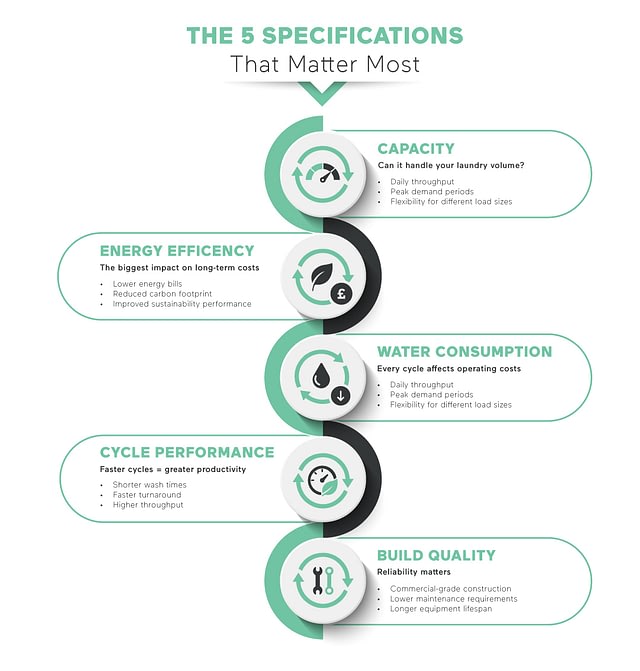
Along with feature-specific information, power output, and reliability metrics, your commercial washing machine specification sheet may also offer insights on the appliance’s build quality and reliability indicators.
For example, you may be able to access a list of the appliance’s internal and external construction materials; stainless steel, for example, is a marker of quality and durability. The spec sheet may also list the warranty, servicing requirements, and maintenance needs, so review this information carefully, questioning anything you’re unsure about.
Step-by-step specification comparison process
It’s easy to overlook key information on a washing machine specification sheet. You might also miss details that will make your machine-vs-machine comparison simpler and more effective.
As such, it’s worth approaching spec-sheet comparisons with a considered strategy. That way you can prioritise critical features and easily whittle down your list of potential options.
Step 1: Draw up a requirements matrix
A requirements matrix is more than just your laundry room wishlist. Sure, there may be features that you and your staff would love to see on new equipment, but this is about prioritising appliances that meet your business needs first and foremost.
Considering each of the categories outlined above, create a list of requirements, features, and priorities. This should become your minimum acceptable performance and capabilities threshold.
For instance, you might conclude that your business needs a machine with a capacity of at least 10kg. Infection control may also be a critical priority, so you’ll need to seek machines with a temperature range of at least 65°C+ to meet this requirement.
Step 2: Evaluate total cost of ownership
A washing machine’s spec sheet provides an effective way to calculate a ballpark cost of ownership for the new appliance. Energy and water consumption metrics, coupled with power output, maintenance requirements, and internal materials, can help you to determine how much the appliance will cost over its lifetime.
Of course, this step isn’t required if you acquire a new washing machine through JLA Total Care. Rather than purchasing a new washer outright, this all-inclusive plan provides new equipment, all-inclusive servicing and repairs, and ongoing support, all for a single monthly cost.
So, with Total Care from JLA, evaluating the total cost of ownership becomes much less important. However, the spec sheet can help you to plan for energy-related overheads, which is an important factor in its own right.
Common specification comparison mistakes to avoid
Comparing new commercial laundry equipment can be challenging, even for the most experienced facilities managers. You need to strike the right balance between budgetary constraints and business needs, while avoiding getting drawn in by bells-and-whistles features that may not add all that much value.
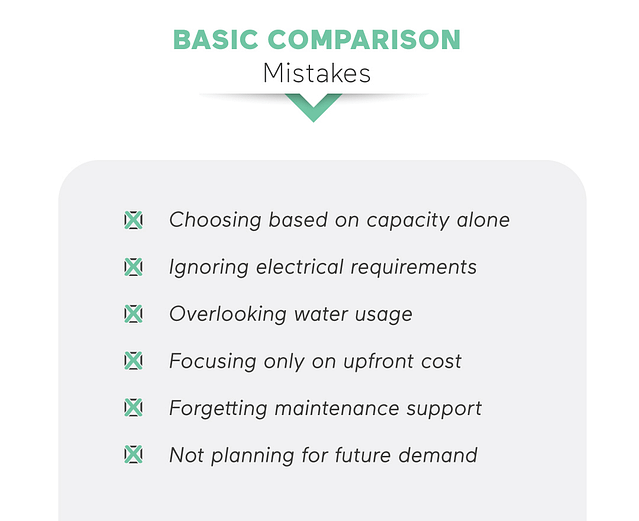
Here’s a list of the common mistakes that facilities managers make when comparing different commercial washers:
- Focusing solely on capacity without considering throughput
- Ignoring power supply compatibility early in the selection process
- Overlooking water quality requirements and pre-treatment needs
- Comparing specifications without considering operational context
Build quality and reliability indicators
Along with feature-specific information, power output, and reliability metrics, your commercial washing machine specification sheet may also offer insights on the appliance’s build quality and reliability indicators.
For example, you may be able to access a list of the appliance’s internal and external construction materials; stainless steel, for example, is a marker of quality and durability. The spec sheet may also list the warranty, servicing requirements, and maintenance needs, so review this information carefully, questioning anything you’re unsure about.
Step-by-step specification comparison process
It’s easy to overlook key information on a washing machine specification sheet. You might also miss details that will make your machine-vs-machine comparison simpler and more effective.
As such, it’s worth approaching spec-sheet comparisons with a considered strategy. That way you can prioritise critical features and easily whittle down your list of potential options.
Step 1: Draw up a requirements matrix
A requirements matrix is more than just your laundry room wishlist. Sure, there may be features that you and your staff would love to see on new equipment, but this is about prioritising appliances that meet your business needs first and foremost.
Considering each of the categories outlined above, create a list of requirements, features, and priorities. This should become your minimum acceptable performance and capabilities threshold.
For instance, you might conclude that your business needs a machine with a capacity of at least 10kg. Infection control may also be a critical priority, so you’ll need to seek machines with a temperature range of at least 65°C+ to meet this requirement.
Step 2: Evaluate total cost of ownership
A washing machine’s spec sheet provides an effective way to calculate a ballpark cost of ownership for the new appliance. Energy and water consumption metrics, coupled with power output, maintenance requirements, and internal materials, can help you to determine how much the appliance will cost over its lifetime.
Of course, this step isn’t required if you acquire a new washing machine through JLA Total Care. Rather than purchasing a new washer outright, this all-inclusive plan provides new equipment, all-inclusive servicing and repairs, and ongoing support, all for a single monthly cost.
So, with Total Care from JLA, evaluating the total cost of ownership becomes much less important. However, the spec sheet can help you to plan for energy-related overheads, which is an important factor in its own right.
Common specification comparison mistakes to avoid
Comparing new commercial laundry equipment can be challenging, even for the most experienced facilities managers. You need to strike the right balance between budgetary constraints and business needs, while avoiding getting drawn in by bells-and-whistles features that may not add all that much value.
Here’s a list of the common mistakes that facilities managers make when comparing different commercial washers:
- Focusing solely on capacity without considering throughput
- Ignoring power supply compatibility early in the selection process
- Overlooking water quality requirements and pre-treatment needs
- Comparing specifications without considering operational context
Facilities managers have a lot of homework to do when comparing new commercial washing machines. The specification sheet of a new appliance can prove a useful tool in narrowing down your search and honing in on the appropriate machine for your needs.
If you need further help and assistance, however, the experts at JLA are always on hand to help. Get in touch today on 0808 239 7578, and we can discuss your requirements.
FAQs
What drum capacity do I need for a 50-room hotel?
Commercial washing machines for hotels with 50 rooms should have a capacity of 20 kg or more. Realistically, a large-scale washer of +25 kg will provide optimal capacity while accounting for future growth and changing requirements.
How do I compare energy efficiency between different brands?
The simplest way is to look at an appliance’s UK Energy Label, which rates the machine on a scale from A to G. You should also drill into the specific metrics, including power consumption in kWh and water consumption in litres per cycle.
What power supply requirements should I expect for commercial washers?
The typical power supply requirements for commercial washing machines in the UK include:
Commercial washer size | Typical supply | Approx. connected load | Typical protection |
7–10 kg | 230 V single-phase | 3–6 kW | ~16–25 A |
12–15 kg | 230 V 1-phase or 400 V 3-phase | 6–12 kW | ~20–32 A |
18–22 kg | 400 V 3-phase | 15–20 kW | 25–35 A |
25–30 kg | 400 V 3-phase | 20–30+ kW | ~32–50 A |
35–40 kg | 400 V 3-phase | 25–40+ kW | ~50–63 A |
50 kg+ | 400 V 3-phase | 40 kW+ | Often 63 A+ |
Which specifications matter most for care home applications?
If you’re the facilities manager in a care home, you need to prioritise the following when comparing new commercial washing machines:
- Maximum load capacity
- Spin speed
- Temperature range
- Infection control features and capabilities
- Power output and installation requirements
- Durability and longevity metrics
How do cycle times affect daily laundry throughput?
Average cycle time has a dramatic impact on your average daily laundry throughput. If an appliance is only capable of a set cycle speed, this could have a knock-on effect across your laundry workflow – resulting in harmful delays that affect how your business operates.
What warranty coverage should I look for in commercial washing machines?
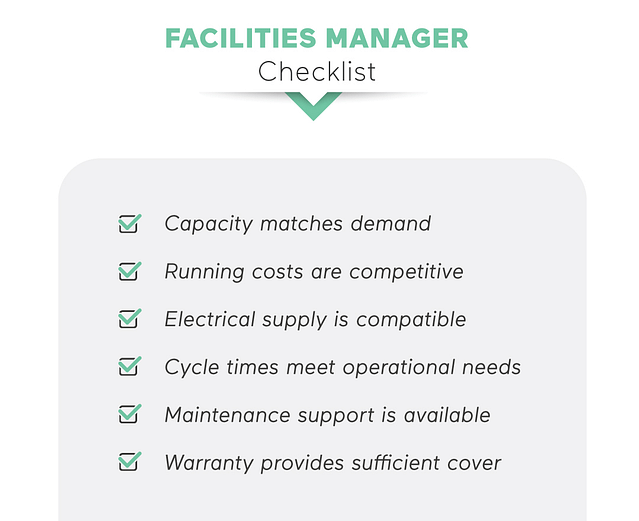
A 2-3-year warranty is generally considered the minimum warranty coverage for commercial washers in the UK. With a solution like JLA Total Care, you get a maximum warranty plus all-inclusive repairs, maintenance, and servicing for the lifetime of the appliance.