
If you’re ready to invest in your catering business, a strategic approach will ensure you get the equipment you need. Asking questions of your chosen catering equipment supplier is key to this, so be ready to interrogate your way to the perfect-fit solution.
Here, we’re taking an in-depth look at questions you should ask when buying new professional catering equipment. From budgeting and financing to aftercare and maintenance – we’ve compiled a list of essential queries to put to your supplier, so you can hone in on the best equipment for your business.

Key takeaways
There’s a lot to tick off the checklist when investing in new catering equipment, so it can help to take a strategic approach. Use the links below for pertinent queries that will help you hone in on the right catering equipment for your needs.
- Budget and financing options available
- Equipment specifications and operational requirements
- Supplier credentials and service capabilities
- Compliance and safety standards
- Maintenance and ongoing support needs
- Return on investment and business impact
Table of Contents
Why asking the right questions matters
There’s a lot to consider when investing in commercial catering equipment. So, carrying out proper due diligence is essential to ensure your new equipment is 100% compatible and delivers optimal durability and performance.
Inadvertently investing in incompatible catering equipment, and the efficacy of your professional kitchen could take a hit. That’s the exact opposite of what you were hoping for – particularly in cases where you’re scaling up operations and pursuing business growth.
Consider, too, that the wrong commercial kitchen equipment could impact compliance and safety. The appliances you invest in must adhere to food safety and H&S standards for your business type, so it’s critical that you interrogate this issue when selecting new equipment.
Ask the right questions of your catering supplier, and you’ll get perfect-fit equipment that saves your business time, money and hassle. No question is too small or inconsequential – better to query small issues now than deal with big problems later.
Budget and financing options available
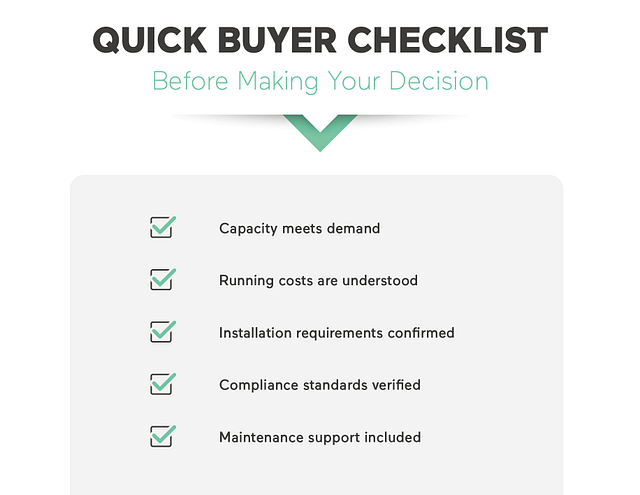
Budget is a priority for all catering professionals, as is the issue of funding and financing your new equipment investment. So, it makes sense to deal with budget-related questions first, so that you can identify appliances that are within your monetary ballpark.
Upfront capital investment vs leasing/rental options
Investing capital in new catering equipment is a major step that can directly impact your cashflow and profit margin. Of course, this might be the most suitable route for some businesses, but others may wish to consider other options first.
When you’re shopping around for new catering equipment, be sure to ask about the availability of equipment leasing or rental plans. These flexible financing arrangements remove the need for a sizeable upfront outlay, so your investment doesn’t impact your immediate cash flow.
A good example of an equipment leasing plan is our own Total Care solution. This all-inclusive plan includes brand-new equipment, free installation, annual servicing and maintenance, and on-demand support. All that for a fixed monthly sum with no upfront outlay.
The components of JLA Total Care reveal some of the hidden costs that you need to question when investing in new catering equipment. For example:
- Does installation cost extra?
- How much will utility connection or changes cost?
- What are the typical maintenance and servicing costs?
- What equipment support and fault troubleshooting are available?
Payment structure and terms
Whether you choose to purchase equipment outright or opt for a financing option like JLA Total Care, there are questions to ask about payment structure, terms, upgrade paths, and equipment refresh cycles.
For instance, does your plan cover you for future upgrades and enhancements? And what is the long-term warranty coverage? Make sure you understand the terms of the financing agreement too, particularly where fair usage is considered; while some plans cover all repairs and maintenance, others may only cover standard issues and definitely not those related to improper use.
Equipment specifications and needs assessment
After budgeting, your purchasing decision will be driven by your unique business requirements. There are three core questions you should answer before you begin searching for new catering equipment, specifically:
- What are your capacity and volume needs? Calculate these by monitoring peak service demand and liaising with your kitchen staff; you should look to invest in new equipment that offers plenty of capacity to accommodate future growth and expansion.
- Are there any space constraints within your catering setup? This will have a significant impact on the equipment you can onboard, so make sure you accurately calculate your available square footage for each appliance.
- Are you hoping to keep any existing appliances? If so, you’ll need to consider compatibility with new technologies. Catering equipment of different generations may not always be compatible; make a note of any equipment you wish to retain, so you can share details of this with your new equipment supplier.
Integration and compatibility
It’s important that any new catering equipment you buy is 100% compatible with your space – whether that’s a professional kitchen or a catering truck. Now is the opportunity to quiz your supplier on the compatibility and integration capabilities of new equipment, taking into account the following:
- Ensure that new equipment is compatible with existing appliances; have a list to hand so you can make absolutely sure that appliances are compatible.
- Inform your supplier of any space constraints, as well as the availability of utilities like power, water, and gas. This could impact the equipment that’s compatible with your space, along with the installation process.
- Consider future scalability and expansion potential. Are there any add-on accessories that you could consider in the future? And what are the opportunities for upgrades and equipment refreshes, depending on your financing plan?
Supplier and service questions
Choosing the right catering equipment supplier is essential in ensuring quality service and long-term durability and performance. You should also consider available support, maintenance, and servicing options, as well as emergency callout procedures and expected wait times.
Let’s take a closer look at some of the key questions you should ask when seeking a reliable catering equipment provider.
Company credentials and experience
Is your equipment supplier a trusted name in the industry, and one with a proven track record? What is their coverage in your local area? And what kind of response time can they offer in case of unexpected faults and breakdowns?
These are some of the key questions you need to ask to ensure you partner with a trusted catering equipment supplier. Look for industry accreditations and certificates, too, as well as reading testimonials and reviews from genuine previous customers.
Installation and training support
How long will it take to install your new equipment? Will there be a significant downtime period? And what documentation can the installer provide to help with future compliance and H&S inspections?
Be sure to quiz your catering equipment supplier on the installation period, including accurate timescales and processes. Make sure you’re up to speed on any training provisions that will be available to you and your staff, too; some companies, including JLA, provide comprehensive equipment handover training, so you can get up to speed on the correct operation of your new equipment.
Compliance and safety standards
Food safety compliance is a key priority for all catering professionals. So, be sure to ask questions relating to how replacement equipment can support ongoing compliance and food safety standards; always ask for supporting documentation and certificates proving compliance with industry guidelines, too.
Regulatory requirements
Ask to see evidence of an appliance’s food safety compliance certification. You’ll need this for ongoing food safety inspections as well as insurance validation, so make sure your supplier can provide this information.
Depending on your sector, don’t be afraid to ask for specific compliance information related to your industry. Reputable equipment suppliers may be able to recommend certain appliances that will better meet the needs of your business – for example, catering equipment for healthcare and education settings may be significantly different than for hospitality venues.
Other elements to consider include fire safety and emergency shutdown procedures, which could impact your long-term fire safety strategy and evacuation plan. Note, too, that you should also seek advice on accessibility and universal design implications, so that you can offer a fully inclusive workplace.
Maintenance and ongoing support
Downtime from unexpected breakdowns is a huge concern in professional kitchens, with the potential to have a drastic short-term impact on your profit margin and cash flow. As such, you need to quiz your supplier on the level of maintenance and support you can expect following your equipment purchase.
Service level agreements
Begin by asking about the availability of routine maintenance and servicing. While some plans like Total Care from JLA offer inclusive maintenance, note that you can also arrange an independent servicing and maintenance plan to cover you against unexpected breakdowns.
Consider, too, your average response times and local service availability. Here at JLA, we guarantee an 8-hour response time to most of our customers, but this won’t be the same for all suppliers. Ask for a means-tested engineer response time where possible, and look for suppliers with strong availability in your local region.
Digital monitoring and asset management
Remote monitoring has been a major breakthrough in modern commercial catering equipment, giving you total oversight of your equipment. In some cases, external monitoring on the part of your supplier can provide streamlined fault resolution, minimising the risk of equipment downtime.
Ask your supplier to provide full details of digital monitoring and asset management solutions. Here at JLA, our myJLA platform offers predictive maintenance and fault detection capabilities, while also providing easy reporting for streamlined compliance.
Return on investment questions
Long-term value and ROI are major concerns for business owners and stakeholders, so you may need to quiz your equipment supplier on the longevity and durability you can expect from your investment.
Of course, equipment lifecycle isn’t the only thing to consider. New appliances should provide efficiency and performance gains, ultimately helping you to take your business to the next level.
With that in mind, here are some key questions to bear in mind.
Operational efficiency gains
Will your new equipment bring tangible performance and efficiency gains? Perhaps a commercial unit with a higher energy rating will help cut energy costs? Or maybe your investment will help to reduce labour costs by prioritising automation?
Consider how your investment will impact the day-to-day efficiency of your commercial kitchen. Ask the right questions to ensure that you’re getting maximum ROI from the equipment you’re interested in.
Business impact assessment
When can you expect that your new equipment will have paid for itself? And what will be the long-term value gains associated with customer satisfaction and service quality?
Evaluate how your equipment investment will positively impact every element of your business. This will give you a clear indication of whether it’s a worthwhile investment.
Making your investment decision
Investing in commercial catering equipment needn’t be stressful, time-consuming, or a drain on your cash flow or budget. With flexible financing options, advanced technologies, and rapid installation and onboarding, you can invest in new catering equipment with confidence.
If you’re looking to upgrade your catering setup, JLA is here to help. Contact us today on 0808 239 7578 to discuss your requirements.
FAQs
What's the difference between buying and leasing commercial catering equipment?
Buying commercial catering equipment means paying for new equipment outright, and typically involves making a significant capital outlay. Meanwhile, leasing or renting new equipment means acquiring equipment for a fixed term on a pay-monthly basis, with no large upfront outlay.
How do I determine the right capacity for my kitchen equipment?
Monitor service periods to gauge how efficiently your business is running. Are there any obvious bottlenecks or pain points that are stifling growth and causing inefficiencies during busy service windows? Liaising with staff is also recommended to assess capacity requirements.
What should I look for in a maintenance contract?
Look for average response times, local support provisions, and out-of-hours callout processes. Read the small print so you know exactly what the contract covers, too.
How important are energy efficiency ratings for commercial equipment?
They’re very important. An energy efficiency rating can affect long-term efficiency and energy savings, as well as compliance and ESG-related issues. Of course, the higher the efficiency rating, the better.
What questions should I ask about equipment installation timelines?
Try to get an exact timescale for the expected downtime period. Before the work begins, ask if there are any preparatory steps which could speed up the install. You should also enquire about access needs and service points, just so that there are no hold-ups which could threaten or delay your install.