

A high-performance kitchen prioritises efficiency, durability and advanced technologies, ultimately helping to reduce overheads while giving catering staff complete culinary freedom. But how do you achieve this? And what type of equipment should you prioritise?
That’s what we’ll explore in this comprehensive resource, as we unpack the core design principles behind high-performance hotel kitchens. We’ve included a shortlist of equipment categories to help cover all bases in your catering space, along with advanced technologies and features to add to your wishlist. So, without further ado, let’s get started.
Key takeaways
- Performance-driven equipment design reduces operational costs by up to 30% through energy efficiency and reduced maintenance needs
- Modular equipment configurations allow hotels to scale operations during peak seasons and special events
- Advanced monitoring systems enable predictive maintenance, preventing costly equipment failures during service
- Ergonomic design features reduce staff fatigue and improve kitchen productivity by 25%
- Integration capabilities allow seamless communication between different kitchen systems
Table of Contents
Core performance design principles
“High performance” is bandied around a lot by marketers, so we thought it was worth framing the term in reference to commercial hotel kitchens. After all, what is it that makes catering equipment “high performance”? And how will it benefit your professional kitchen?
What are the benchmarks of a high-performance commercial kitchen?
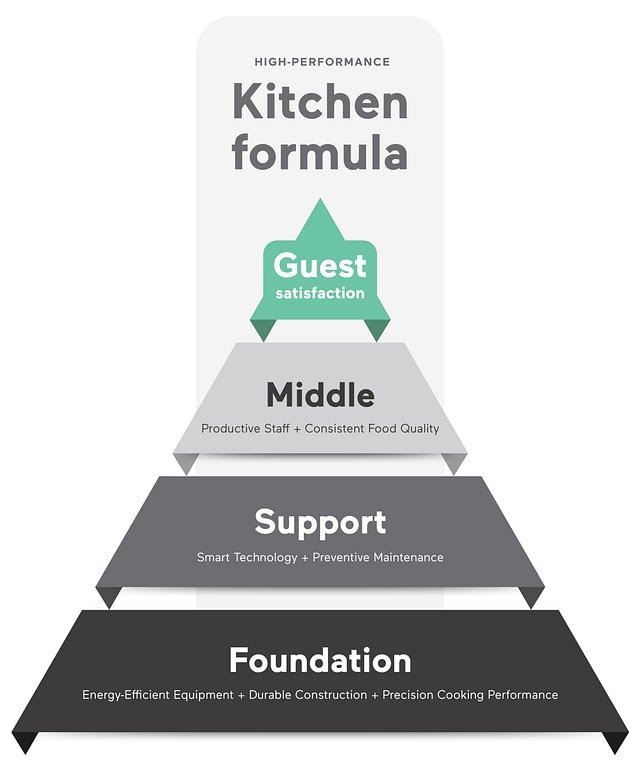
In reference to commercial kitchens and catering setups, we use high performance as a catch-all term for characteristics like efficiency, durability, and the presence of advanced technologies. Based on our experience working with professional caterers, these are the attributes that chefs and kitchen managers look for from new commercial kitchen equipment.
Efficiency
Given that energy now accounts for a significant portion of a kitchen’s monthly overheads, it’s no surprise that it’s become a priority for professional caterers. Of course, there’s also the potential ESG impact to consider – particularly if you’ve integrated sustainability claims into your hotel’s ethos.
Efficient commercial catering equipment saves energy and resources through the use of advanced energy-saving technologies. These include:
- Efficient heat recovery, specifically in commercial dishwashers and HVAC systems
- Automatic standby/power downs
- Variable temperature control for precise food preparation
- The integration of smart technologies for monitoring energy consumption
- Accurate temperature control – no guesswork means less energy wastage
Durability
The main difference between commercial and domestic kitchen equipment is durability. Professional catering appliances are built from premium materials like stainless steel and constructed to a high specification. They also feature advanced components that have been machined with absolute quality and care, so you get exceptional power and performance.
Replacing commercial catering equipment is rarely a fun task for hotel managers, given the perceived outlay requirements and the risk of downtime during busy service periods. So, investing in high-performance equipment that’s durable and long-lasting is always a priority, and will mean less maintenance, servicing and repairs, too.
Advanced technologies
For hotel chefs and caterers looking to push the culinary envelope, prioritising kitchen equipment that integrates advanced technologies provides boundless opportunity for creativity. If you want to cook exciting food, then high-performance tech with next-gen features is a must.
Take modern combi ovens, for example. These systems give you the freedom to steam, fry, bake or braise, all in one appliance. Commercial induction hobs also represent a major leap forward for high-performance kitchen equipment, helping you reduce energy consumption by up to 90%.
It’s not just cooking and food preparation equipment that’s loaded with advanced tech, either. Smart features extend to other essential kitchen tools, too, including commercial dishwashers. A great example of this is VAPOSTOP, an integrated feature that prevents steam escape after each cycle – a simple innovation, but one that could prove a difference-maker in your hotel kitchen.
Critical equipment categories for hotel kitchens
There are three main categories that hotel kitchens need to hit to cover all bases from an equipment provision standpoint: cooking, refrigeration and food storage, and sanitation and warewashing. Let’s take a closer look at these equipment classes in turn, along with their performance requirements.
Commercial cooking equipment
Cooking equipment is where the magic happens in a hotel’s kitchen, whether it’s rustling up tasty guest breakfasts or pushing for a Michelin mention with a perfectly executed evening service. Of course, the exact cooking appliances you’ll need will depend on the type of meals you specialise in; happily, there’s plenty of flexibility, as well as scope to branch out by embracing new technologies.
Central to any commercial kitchen is a reliable, high-performance oven, and there are several options to choose from depending on your needs. As mentioned earlier, combi ovens excel in versatility, while commercial range ovens offer outstanding performance and reliability in a familiar, user-friendly format.
Looking to expand the type of cuisine your hotel kitchen dishes up? A high-performance pizza oven could be a worthwhile investment. Commercial bratt pans, bain maries and hot cupboards also play a key role in hotel kitchens, particularly those that offer buffet-style dining.
Refrigeration and food storage
High-performance refrigeration units are critical in hotel kitchens, and central to ongoing food safety compliance. You’ll need to consider food storage provision, too, with durable and secure units in place to maximise hygiene, cleanliness and organisation.
Professional fridges and freezers have come on leaps and bounds in recent years, thanks in part to the integration of smart technologies and advanced features. It’s now possible to monitor and adjust internal temperatures to within a single degree of accuracy, which is ideal for maintaining optimal food safety.
High-performance refrigeration equipment now includes appliances like commercial blast chillers, which is capable of reducing food temperature from 90°C to 3°C in just 90 minutes. This not only ensures optimal hygiene, reducing the risk of bacterial growth, but it also helps retain food freshness and flavour.
Warewashing and sanitation
Investing in high-performance dishwashers, glass cleaners and utensil washers might not sound all that exciting, but such appliances are an important cog in the machine of any hotel kitchen. There are a variety of options to suit kitchens of different capacities, so the appliance you need will depend on the size and scope of your hotel.
If, for example, you offer a popular breakfast service with hundreds of daily covers, you might need a high-performance pass-through dishwasher capable of near-continuous crockery cleaning throughput. Alternatively, if you’re tight on space in your boutique hotel’s on-site kitchen, a top-spec undercounter dishwasher rated for professional use offers compact usability without compromising performance and hygiene.
It’s worth noting that modern, high-performance kitchen warewashers are loaded with advanced features designed to save water and energy. Heat recovery, intelligent filtering, and water-saving programmes are some of the features you can expect, while many appliances also feature onboard data recording, which makes those H&S inspections significantly easier to manage.
Advanced technology integration
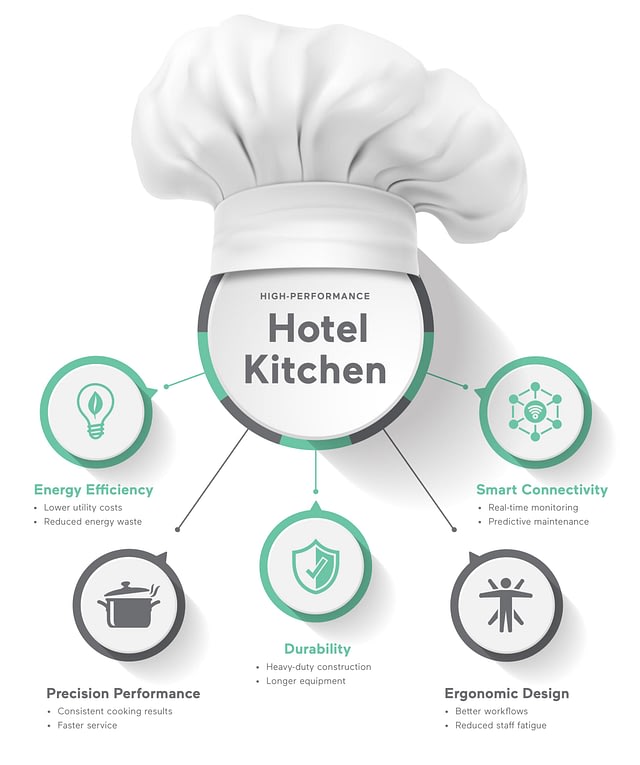
Digital transformation has changed the way professional kitchens work for the better. Improved oversight, predictive maintenance and servicing, and full connectivity with third-party systems are some of the attributes that advanced technology integration has brought to the table – ultimately making your hotel’s kitchen easier to manage.
Smart monitoring and predictive maintenance
Thanks to the emergence of IoT (Internet of Things) sensors, real-time equipment monitoring is possible across every appliance in your commercial hotel kitchen. Smart monitoring not only improves general oversight, but also makes it possible to analyse energy consumption, identify inefficiencies, and diagnose faults before they turn into service-halting issues.
Integration with kitchen and hotel management systems
Guesswork is a thing of the past in modern commercial kitchens, with interconnectivity between different internal systems eliminating operational blind spots. You can now connect your kitchen equipment directly to your POS and inventory systems, reducing your reliance on error-prone manual processes, while always ensuring that your catering teams have the products and tools they need to deliver.
Future-proofing equipment design
Investing in new equipment for a commercial hotel kitchen can leave you with a niggling doubt about whether you’re making the right decision, particularly when it comes to future-proofing and reliability. Ultimately, you want appliances that will stand the test of time without instantly being overshadowed by the next big thing.
From our perspective, commercial kitchen equipment is trending towards enhanced connectivity and the integration of smart technologies. The benefits of such appliances are clear, and the great thing about them is that you can update their onboard software moving forward, so you won’t get left behind.
Of course, future-proofing a hotel kitchen is about more than just responding to the latest catering equipment trends; you need to make sure you have the capacity to scale up your operations should demand increase.
When planning a high-performance hotel kitchen, consider modular design which gives you the freedom to add and remove elements in the future, without major infrastructural change. You should also invest in equipment that offers higher capacity and performance metrics than you currently need; that way, you can scale up your operations should your growth curve begin to track in the right direction.
FAQs
How do you measure the performance of hotel kitchen equipment?
There are lots of metrics that can be used to calculate kitchen equipment performance. Water and energy consumption, power output, and even diner experience all provide a clear indicator of how positively your hotel kitchen is performing. As such, a holistic approach may be needed when appraising the current performance of your catering space.
What's the typical ROI timeline for high-performance kitchen equipment?
Based on resource savings and an increase in hotel restaurant footfall, you can expect high-performance catering equipment to have paid for itself in approximately five years on average. Of course, this is only a ballpark estimate, and your ROI timeline will vary significantly depending on a range of factors – from the state of your previous equipment setup to your average number of covers during peak periods.
How does equipment design impact food safety compliance?
Modern, high-performance kitchen equipment is built with food safety compliance at its core, and there are many advanced features now in place that are actively designed to make H&s compliance simpler for catering teams.
For example, onboard smart connectivity sensors make it much simpler to gather data ahead of scheduled H&S inspections, while accurate temperature recording and control mean more assured food storage.
How can smart technology reduce operational costs in hotel kitchens?
The integration of smart technologies has had a profound impact on the cost of running a commercial hotel kitchen. Interconnectivity between different systems removes the need for manual input, meaning reduced wastage and more cost-effective budgeting. Such technologies also provide greater oversight of energy and water consumption, giving you the opportunity to make efficiency-boosting changes to your daily kitchen workflow.
What are the key differences between standard and high-performance equipment?
Standard kitchen equipment may be cheaply made, lacking premium materials that ensure long-term durability and performance. It may also lack the integration of advanced technologies, which can bring genuine benefit to a hotel’s kitchen – be it reducing overheads, saving energy, or offering streamlined service periods.
That’s a wrap on our guide to designing a high-performance hotel kitchen – we hope it’s offered some food for thought on the equipment and technologies to prioritise in your catering space. Should you need further inspiration and advice on upgrading your commercial kitchen, the team at JLA is here to help. Call us today on 0808 239 7578, and we’ll take care of you.