

A commercial kitchen degreaser is the ultimate tool for tackling grease, grime, and burnt-on food in your catering business. But which type of professional degreaser will work best in your kitchen? This guide can help you decide.
Here, we’re taking a look at the four main types of commercial kitchen degreasers, including water-based, solvent-based, foaming, and enzymatic products. We’ll also share some tips on sourcing the best cleaners for your professional kitchen, as well as advice on how to use degreasers safely and effectively to maintain peak levels of food safety, hygiene, and cleanliness.
Key takeaways
- Commercial kitchen degreasers are mandatory for food safety compliance and health regulations
- There are four main types available: water-based, solvent-based, foaming, and enzymatic degreasers
- Proper degreaser selection depends on surface type, grease level, and cleaning frequency
- Regular degreasing prevents fire hazards and maintains equipment longevity
- Professional application methods ensure maximum effectiveness and safety
Table of Contents
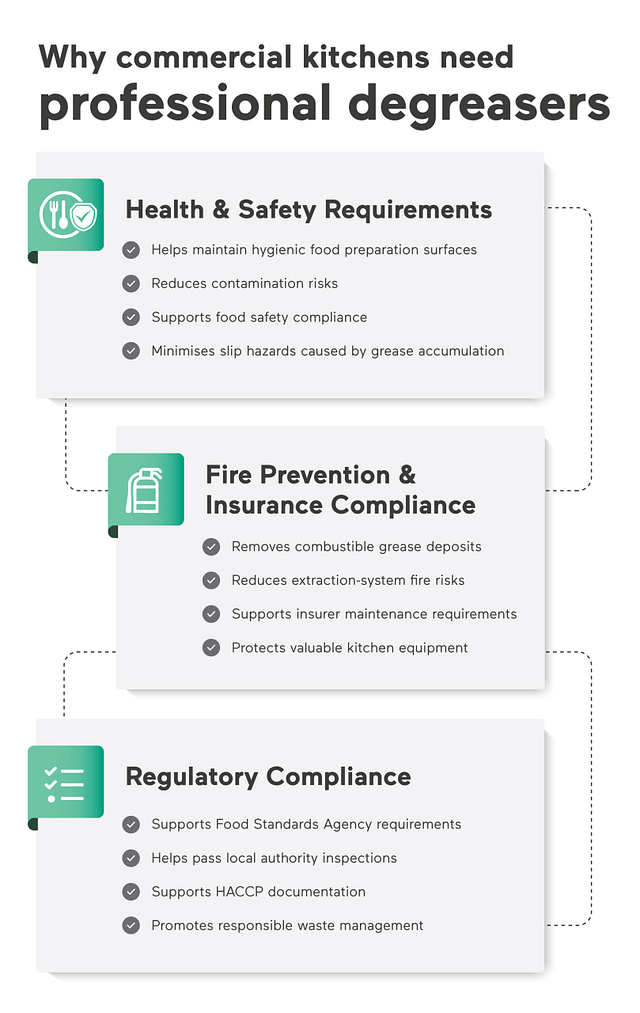
Why commercial kitchens need professional degreasers
If you’re new to the catering industry or taking your first steps towards opening a commercial kitchen, you may be wondering what the big deal is around commercial-grade degreasers. After all, surely any old cleaning product would do the job just fine, right?
Wrong. Not only are commercial kitchen degreasers specially formulated to eliminate harmful grease and grime, but using them is tied to general food safety and hygiene in the kitchen. They play a key role in fire prevention, too, making them pretty indispensable.
Let’s take a closer look at the why of using kitchen degreasers in your commercial kitchen.
Health and safety requirements
Although using a professional degreaser isn’t a legal requirement, keeping your kitchen clean is. And since commercial-grade degreasing products are among the best in the biz for cleaning up dirt, grime, and burnt-on debris, it makes sense to use them as part of your daily cleaning workflow.
The UK Food Standards Agency has a variety of health and safety rules in place to ensure that professional kitchens and catering businesses keep work areas hygienic and spotlessly clean. Part of this involves effectively removing grease and food residues, so what better to use than a degreasing product?
Health and safety inspectors will want to see evidence that your kitchen is clean and free from dirt, grease, and grime, all of which can attract bacterial growth if left unchecked. They’ll review your arsenal of cleaning products while quizzing you on your daily cleaning routine, so you’ll need to be prepared and have the right products to hand.
Fire prevention and insurance compliance
Did you know that regularly using a commercial-grade kitchen degreaser is one of the most effective ways to prevent fire? This makes sense when you consider how flammable many greasy substances are, particularly if they’re present near commercial ovens and open-flame hobs.
Not only that, but airborne grease, dirt, and grime can easily coat other surfaces too, including those connected to your broader HVAC system; extractor fans, for example. This can present its own fire and smoke-related hazards, so using a professional degreaser on such components is critical in early prevention.
Note, too, that your insurance company will require you to clean your kitchen in line with current H&S best practices. Some policies may even include wording around the specific products they expect you to use to maintain peak cover; failure to do so could void your policy and leave you in dire straits should the worst happen.
Types of commercial kitchen degreasers
There are four types of commercial kitchen degreasers that you can use to tackle grease and grime on your premises. We recommend using a combination to ensure effective cleaning on different substances, as some products may be better suited to different applications than others.
With that said, let’s introduce you to the four degreaser categories, showcasing their characteristics and examples of where they can be used effectively.
Water-based degreaser
What is it? | A general kitchen degreaser that can be used on a variety of messes. Water-based degreasers typically contain surfactants which break down greasy residue on contact. |
Benefits | Easy to work with, water-based degreasers are perfect for everyday cleaning and produce a low odour. |
Drawbacks | Some water-based degreasers may not be 100% effective on all greasy residues. |
Solvent-based degreaser
What is it? | Solvent-based degreasers are used for heavy-duty cleaning. They contain organic solvents which penetrate and break down oily material. |
Benefits | Solvent degreasers are perfect for use on stubborn dirt and grime, powering through the toughest stains and marks. |
Drawbacks | These products can be hazardous and require full PPE; many also produce strong odours. |
Foaming degreaser
What is it? | Foaming degreasers are exactly what they sound like: cleaning products that produce foam. This makes them great for cleaning hard-to-reach areas and dissolving stubborn grime. |
Benefits | Foaming degreasers produce a layer of foam that actively dissolves grease and grime on contact, even in hard-to-reach areas. |
Drawbacks | Be aware of the manufacturer-recommended “contact time” – the safe time frame for leaving foaming degreasers to do their thing. |
Enzymatic degreaser
What is it? | Enzymatic degreasers offer the cleaning power of solvent-based products without the strong odour and harsh chemicals. They contain enzymes that break down grease and fatty residues. |
Benefits | Enzyme-containing degreasers are great for food preparation areas, since they contain few harsh chemicals while powering through tough grime. |
Drawbacks | The efficacy of these cleaners can be affected by different factors, including water temperature and pH levels. |
Choosing the right degreaser for your kitchen
Familiarising yourself with the various different types of kitchen degreaser is one thing – knowing which one you need is another.
While we generally recommend using a combination of different cleaning products depending on the application, it’s true that some degreasers may be better suited to your professional kitchen than others. So, here are some hints and tips on how to select the right kitchen degreaser for your catering business.
Consider your day-to-day cooking methods
The amount of grease and grime your kitchen produces will largely hinge on the type of food you prepare along with the commercial catering equipment you use to produce it.
For instance, if you regularly use deep-fat fryers and similar cooking appliances, you’ll certainly be at higher risk of grease build-up. And that includes on general food prep surfaces as well as in your extractor system. As such, you may require a heavy-duty degreaser that can easily handle oily and fatty residues.
Cleaning processes and schedule
Different kitchens have different cleaning routines, based largely on their day-to-day service schedule as well as staffing levels.
For instance, some caterers may take a clean-as-they-go approach, with assistants responsible for keeping surfaces clean and grime-free during a busy kitchen service period. Meanwhile, others may only have the resources available for end-of-day cleaning.
Naturally, this could affect the type of cleaning products you use. For general cleaning throughout the day, a water-based degreaser may be sufficient to maintain peak cleanliness; for end-of-day cleaning, a foaming, solvent-based, or enzymatic degreaser may be required to cut through build-up, burnt-on food, and stubborn grime.
Surface compatibility
Before you start using a commercial-grade kitchen degreaser, you must test it on an inconspicuous area. Some degreasers – particularly those containing powerful cleaning solvents – may not be suitable for all kitchen surfaces and food preparation areas, so this could ultimately dictate the type of products that are safe to use in your commercial kitchen.
Best practices for degreaser application
Applying degreasers may seem self-explanatory, but it’s important to follow manufacturer guidance and general H&S best practices to ensure optimal results. With that in mind, let’s take a closer look at the how of using professional degreasers in your commercial kitchen.
Safety procedures
Before you even think of squirting any degreaser around your kitchen, there are some H&S procedures you’ll need to take care of to ensure safe and effective cleaning. These include:
Wearing the appropriate PPE: Rubber gloves are non-negotiable, while eye protection and face masks may be required when using strong solvent-based cleaners.
Adequate ventilation: Where possible, open windows and switch on extractor fans to allow maximum ventilation and airflow when using chemical degreasers, particularly if they produce bad odours.
Chemical handling and storage: Always read the label to understand how to safely store chemical cleaners in your commercial kitchen. Careful handling is essential, too.
Emergency procedures and first aid: Ensure you have protocols in place to deal with chemical burns and splashes; a watch station and first aid is essential when using these products.
Application techniques
You’ll get better results with less effort if you use professional degreasers as the manufacturer intended. Here are some essential tips to steer you in the right direction:
Shut down equipment where necessary: For instance, any heat-producing appliances, like stoves and hobs, may need to be shut down and disconnected when using specific degreasing products.
Ensure correct dilution and mixing: Read the product label to ascertain whether you need to dilute or mix the cleaner prior to use. This may be necessary on certain surfaces, so always check before you apply.
Consider the contact time for maximum efficacy: While it may be possible to spray on and wipe off in some instances, some degreasers work best when left to work for a few minutes, particularly on stubborn grime and burnt-on debris. Check the product information carefully and stick to the recommended contact times.
Rinsing and sanitisation: It’s critical that you remove any leftover residue after using a kitchen degreaser, potentially with another chemical-safe sanitising product. Rinse thoroughly for clean, perfectly sanitised results.
FAQs
How often should commercial kitchens be degreased?
That depends on the type of food you prepare, the cooking appliances you use, and how busy your service periods are. Generally, it’s recommended that professional kitchens are degreased at least once a day to prevent the build-up of stubborn grease, grime, and burnt-on food, while maintaining compliant food hygiene and cleanliness standards.
What's the difference between degreasing and regular cleaning?
Degreasing means using products specifically designed to break down oily substances, fats, and other grease-forming substances. You can use general surfactants and cleaners instead, but these might not be sufficient to prevent build-up and remove the most stubborn deposits.
Are enzymatic degreasers safe for food-contact surfaces?
Yes, some enzymatic degreasers can be safely used on food-contact surfaces. However, not all products are suitable for this application, so choose products wisely.
How do I dispose of used degreaser solutions properly?
Check the product’s Safety Data Sheet (SDS), particularly Section 13, which covers “Disposal considerations”. Never dispose of degreasing solutions in a surface water drain; instead, collect them in a compatible container and dispose of them via an authorised chemical waste disposal unit.
Can I use household degreasers in a commercial kitchen?
That’s possible, but you may not get the best results. Household degreasers aren’t formulated to the same standard as their professional counterparts, so you may need to use more product and more elbow grease to achieve the same results.
What training do staff need for safe degreaser use?
Make sure that staff are up to speed on the PPE requirements when using strong kitchen cleaners like degreaser solutions. You’ll need to train them in correct chemical handling, storage, and disposal, too, as well as highlighting usage tips like optimal contact time and dilution.
We hope this comprehensive resource has helped you get to grips with professional kitchen degreasers and where, why, and how they can be used in your catering business. JLA stocks a variety of professional kitchen cleaners and degreasers, and we can advise you on the right products you need for the job. Call us on 0808 239 7578, and we’ll be happy to help.