

Water and energy represent the biggest overheads that hotels face. So, finding ways to curb consumption and reduce bills in your commercial laundry room could be an effective way to start making inroads towards more cost-effective operational overheads.
As a business leader, you want to make the right, cost-effective decision when it comes to replacing critical equipment. But striking the balance between short-term affordability and long-term efficiency can be tricky, to say the least.
Here, we’re taking a closer look at the budget-vs-premium debate, giving you essential food for thought before you commit to a purchase decision. That includes the average cost of ongoing maintenance, servicing, and repairs, as well as a couple of useful formulas that can help you calculate your long-term ROI and your prospective payback period.
Key challenges at a glance
- Cheaper equipment costs 3x more in maintenance and repairs over its lifetime
- Energy-efficient commercial equipment reduces operating costs by up to 50% annually
- Quality equipment lasts 15-20 years vs 5-7 years for budget alternatives
- Total Care contracts eliminate upfront costs while providing premium efficiency
- Downtime from cheap equipment failures costs businesses £500-£2,000 per day
- Energy-efficient models may qualify for government incentives, reducing net investment
Table of Contents
The true cost of “cheap” commercial equipment
We recognise that opting for cheap replacement equipment might seem like the right step for your business. After all, with day-to-day budgeting pressures and short-term financial health to consider, choosing affordable over premium may provide some immediate headroom – shielding you from significant capital outlay.
However, selecting cheap equipment may not prove to be the smartest long-term strategy, particularly when you factor in running costs, more frequent maintenance and repair overheads, and a shorter overall equipment lifespan.
Let’s take a closer look at some of the other hidden costs associated with inferior commercial equipment.
Hidden maintenance and repair costs
It doesn’t take a genius to figure out that affordable equipment will have a higher lifetime repair bill than the equivalent high-quality unit. Premium components and superior build quality generally mean that more expensive equipment will last longer and require fewer repairs, although preventative maintenance and servicing remain fundamental to optimising an appliance’s quoted lifespan.
With that said, here’s a direct comparison between budget and high-quality equipment, demonstrating the significant void in maintenance-related costs between the two.
Maintenance area | Budget equipment | Premium equipment |
Annual preventative maintenance | £250-£500 | £300-£600 |
Average reactive repair costs | £500-£1,500 | £150-£600 |
Replacement parts | Cheaper replacement parts, needed more frequently | More expensive replacement parts, needed less frequently |
Labour costs | Higher due to more frequent breakdowns | Lower to less frequent breakdowns |
Downtime costs | High – significant risk of disruption and potential loss of earnings | Low – although risk of disruption and potential loss remains |
Emergency call-outs | Plan for 2-5 call-outs a year | 1-2 per year (0 if you’re lucky) |
Expected service life | 7-10 years | 15+ years |
Lifetime maintenance spend | £8,000-£15,000+ | £3,000-£8,000 |
This chart demonstrates better than any other set of statistics just how seismic the void between budget and high-quality commercial equipment can be. By opting for budget equipment as a short-term cost-saving measure, you could stand to pay significantly more in the longer term – so, perhaps it’s better to take the hit and benefit from a more nominal lifetime maintenance spend?
Downtime impact on business operations
Downtime is one of the hidden costs associated with interior equipment, and it poses a detrimental risk to your business. The impact goes well beyond simple budgeting considerations, too, with the potential to cause disruption and continuity issues across your operations.
Here are some examples of the ill-effects that equipment downtime can have on your business, reiterating the importance of opting for quality replacements versus cheap alternatives.
- Significant reduction in productivity
- Increased labour costs to pick up the strain in key areas of your business
- Reduced capacity at critical points along your operational workflow
- Customer dissatisfaction, compounded by poor reviews that could affect long-term revenue
- Direct loss of earnings, placing significant strain on your cash flow
- Compliance risk – bad news if you suspect a H&S inspection could be imminent
Long-term efficiency: The smart investment strategy
Even after seeing the potential saving figures written in black and white, some businesses may feel they have to take the short-term-thinking approach – even if it’s just as a way to protect their working capital and operational budget.
However – and if only to hammer home our point about seeing the bigger picture when it comes to investing in more expensive equipment – long-term efficiency and productivity are almost always better value than any savings you would make from opting for cheaper but ultimately inferior equipment. And it just so happens that there are a couple of formulas you can use to calculate this based on projected real-world savings.
How to calculate the ROI of your equipment purchases
The first formula we’d like to shine a light on is the basic ROI formula, which you can use to get a handle on the potential long-term financial benefits of a particular equipment purchase.
ROI (%) = ((Total Financial Benefits − Total Investment Cost) ÷ Total Investment Cost) × 100
Of course, this requires you to have a pretty accurate understanding of the potential financial benefits of a particular appliance, which may be tricky to figure out on accurate, real-world terms.
So, instead, you might like to try the payback period formula, which can be used to get a gauge on when a new equipment purchase will have paid for itself in long-term savings.
Payback Period = Purchase Cost ÷ Annual Savings
Although the payback period formula also relies on an understanding of the total annual savings that new equipment will deliver, these figures should become obvious when you start using a particular appliance. You might like to lean on smart meter data or a machine’s in-built cycle tracker to attain the figures required to calculate your machine’s payback period accurately.
Energy savings analysis
With mounting energy costs and ESG (Environmental, Social and Governance) targets to consider, anything you can do to curb your electricity, gas, and water consumption could prove extremely beneficial – not least to your bottom-line profits.
The question is, how do high-quality appliances built for long-term efficiency compare to their cheaper equipment counterparts, purely from an energy savings perspective? Let’s take a look.
Cost metrics | Budget equipment | Premium equipment |
Electricity/gas | Higher | 25-40% lower |
Water | Higher | 30-50% lower |
Carbon | Higher | Significantly reduced |
Maintenance costs | Higher | Significantly reduced |
Government incentives and tax breaks
Did you know that there are a variety of government incentives, tax breaks, and other relief schemes afforded to businesses that choose energy-efficient equipment? Such grants may offset the cost of purchasing more premium appliances, making your final budget-vs-premium purchase decision even simpler.
Let’s take a closer look at some of the schemes and incentives you may qualify for…
- Industrial Energy Transformation Fund (IETF): Available to energy-intensive businesses with industrial-grade equipment requirements, the IETF offers grants for purchasing efficient industrial machinery. Learn more.
- Ofgem business energy grants and schemes: Ofgem provides a list of grants and incentives for UK SMEs and micro businesses. Learn more.
- Local authority funding for decarbonisation efforts: Most local authorities have a pot set aside to help businesses with the green energy transition. Don’t be afraid to contact your local authority before making a new equipment purchase to see if you qualify for financial aid.
Total cost of ownership: The complete financial picture
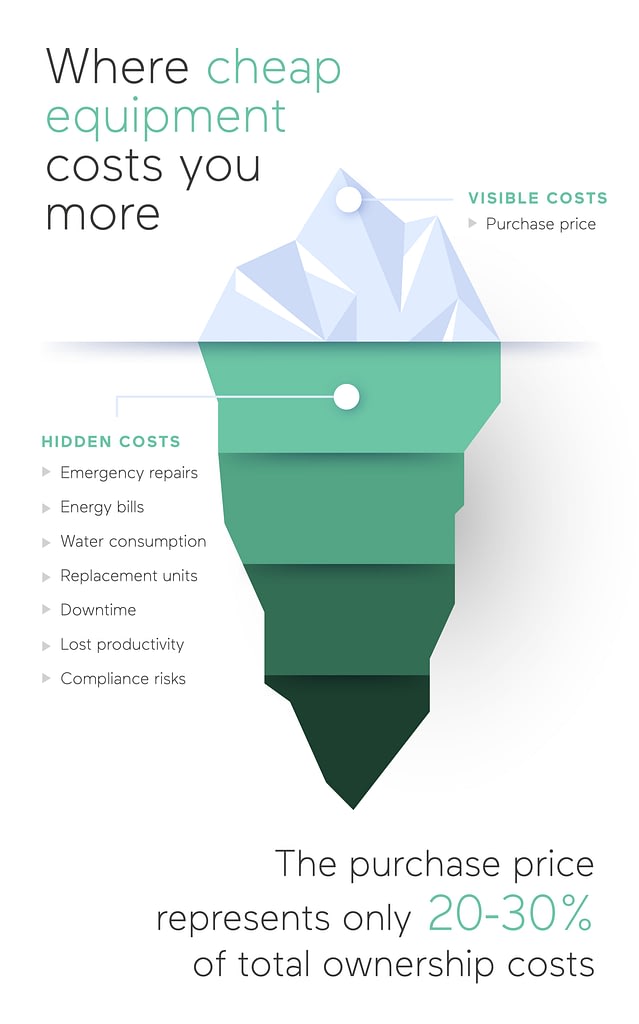
When it comes to replacing equipment on your premises (or, indeed, investing in new value-add appliances), you need to look beyond the initial price tag and instead consider the total cost of ownership. This is the best way to approach the budget-vs-premium purchase decision, as it often provides a clear winner.
There are several different factors that you should consider when calculating the long-term cost of your commercial equipment. Taking this holistic view, you may feel differently about taking the perceived easy route and opting for the cheapest-possible option right off the bat.
Here’s a complete overview of the total cost of ownership (TCoO) of a single piece of equipment, ranked by its impact on how much you can expect to pay over time.
TCoO factors | Budget | Premium | Long-term impact |
Initial purchase price | Low purchase price – immediate perceived benefit. | High initial purchase price. | Limited long-term impact – particularly with financing options. |
Energy | Higher energy costs due to less efficient operation. | Lower energy costs thanks to higher efficiency. | High long-term impact, with significant savings possible. |
Maintenance | Higher maintenance requirements, with potential for costly repairs. | Lower maintenance requirements, although preventative servicing is still needed. | Very high long-term impact, with significant savings possible. |
Lifespan | Reduced overall lifespan, necessitating earlier replacement. | Longer overall lifespan. | Very high long-term impact, particularly if premature replacements are needed. |
Future-proofing your equipment investment
As we’ve alluded to at various junctures throughout this guide, any investment you make needs to be future-proofed with the right approach. This applies whether you’re purchasing premium equipment or taking the budget approach.
But what exactly constitutes “future-proofing” when it comes to commercial equipment? Here are a few tips and suggestions…
- Commit to a strict maintenance and servicing schedule: Whether it’s a commercial washing machine or a new blast chiller for your catering business, preventative maintenance is key to future-proofing
- Utilise digital monitoring capabilities: Many modern commercial appliances feature on-board digital monitoring capabilities. This allows you to monitor energy consumption, cycle performance, and maintenance/servicing information, all of which can prove exceedingly useful in optimising your equipment’s performance, efficiency, and lifespan.
- Choose scalable equipment: We often emphasise the need to purchase equipment that offers a degree of scaling, so that it supports business growth and continuity over the lifetime of the product. That might mean opting for a commercial washing machine with more capacity than you currently require, for example.
FAQs
How much can energy-efficient commercial equipment save on utility bills?
Energy-efficient commercial equipment can offer significant savings on energy bills versus budget appliances that don’t prioritise efficiency. Although the average savings will depend on the appliance in question, you’re typically looking at a 20-50% energy efficiency benefit.
What is the typical payback period for premium vs budget equipment?
You can use our formula to calculate the typical payback period you can expect from premium or budget equipment. It may be the case that more expensive equipment pays for itself faster than budget models, particularly when you incorporate prospective energy savings and reduced maintenance requirements.
How does Total Care compare to traditional equipment leasing?
Total Care is an all-inclusive equipment plan, incorporating everything from free installation and repairs to an annual service in line with manufacturer recommendations. You also get access to myJLA and JLA Connect, so you can easily control and manage your equipment.
What maintenance costs should I expect with cheaper equipment?
Cheaper commercial equipment may incur additional maintenance, servicing, and repair bills. You might wind up paying for replacement parts more regularly than you would with premium alternatives, while unexpected breakdowns can also bring about the hidden costs of equipment downtime.
Are there financing options for energy-efficient commercial equipment?
Absolutely! JLA offers a range of financing options across all its commercial equipment, including our beloved Total Care solution.
So, there you have it: cheap is cheap when it comes to commercial equipment, and you may wind up paying more over the lifetime of your appliance than you would with a premium model. Remember, too, that if you need to upgrade your equipment, JLA offers a range of financing options which can remove the need for a heavy initial outlay. Contact our experts today on 0808 239 7578 to discuss requirements.