
For housing teams with tight budgets to balance, equipping communal laundry rooms with domestic laundry equipment is an attractive solution. After all, domestic washers and dryers offer residents a familiar experience, are comparatively cheap to buy upfront, have a smaller footprint, and, on paper, are more than up to the job of washing clothes, towels and other day-to-day items.
But communal laundries also ask a lot more of washers and dryers than the average home, with multiple households using them throughout the day, and residents expecting consistently good results, load after load.
Read on to see why choosing commercial makes sense for housing providers.
Key challenges at a glance
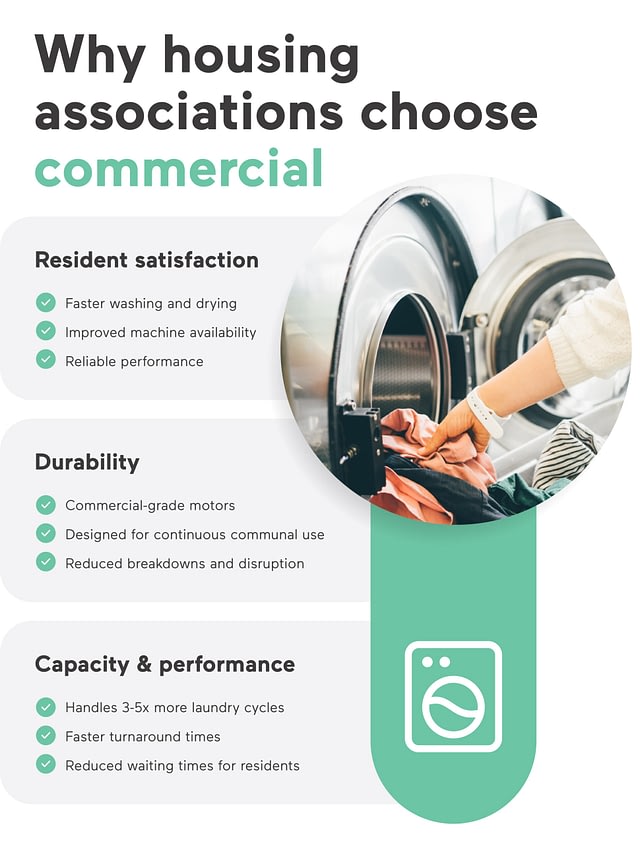
- Commercial machines are tested for up to 30,000 cycles, compared to roughly 5,000 for domestic equivalents – meaning they handle 3 to 5 times more daily use without performance degradation.
- Commercial dryers include advanced fire suppression technology such as S.A.F.E. systems, significantly reducing property damage risk in communal laundry rooms.
- Water regulation compliance is built into commercial equipment, reducing liability risks for social housing providers.
- Planned preventative maintenance contracts for commercial machines provide predictable costs with rapid engineer response, often within hours.
- Smart technology in commercial laundry machines – including auto-dosing, load sensing, and heat recovery – can reduce energy waste by up to 40% compared to domestic alternatives.
- Superior moisture extraction in commercial washers and dryers helps prevent the damp and mould issues that plague many housing settings.
Table of Contents
Understanding types of laundry equipment for housing associations
What counts as commercial laundry equipment?
One key difference between commercial-grade and domestic laundry machines is that the former are designed and engineered for repeat use, and tested well beyond the limits of a unit you’ll only use a few times a week at home.
Commercial appliances’ tougher construction makes them much more suitable for the demands of a communal laundry, and means they’ll deliver consistent performance, with less hassle, for many years. What’s more, they’re made to meet the safety standards expected of a responsible housing association.
Load capacity is another huge difference. Most domestic machines can handle loads between 6kg and 7kg, which is usually plenty for most people’s standard wash loads, but not always enough to handle larger or heavier loads, like towels or bedding. Commercial equipment, on the other hand, offers capacities from 8kg right up to 28kg, as well as extra controls and programmes to suit different needs.
What’s more, coin-operated, RFID and contactless payments options can come built in, supporting both user convenience and simpler management on your end.
What are the drawbacks of domestic equipment in shared housing?
Domestic washers and dryers are designed for normal household use, not near-constant loads. Practically speaking, this means that, in a busy communal laundry, their components are far more likely to wear out faster, increasing the chance of breakdowns, surprise repair bills, or – in the worst cases – full replacements.
But it’s also the case that smaller capacities of domestic machines can slow the wash process for many households, who may be forced to run multiple loads. For other residents, this can mean more waiting, and potentially even frustration.
By offering faster cycle times, not to mention greater throughput, commercial machines usually become free again, sooner – and give busy residents a chance to get their washing and drying finished on the same day.
It’s also worth knowing that using a domestic machine in a commercial or shared setting can also invalidate its warranty, potentially leaving you exposed to unwelcome extra costs if something goes wrong.
Comparing durability and robustness
Commercial equipment offers better build quality
With occasional use, a modern domestic washing machine should produce great results for the majority of households. In a communal laundry room, however, it’s going to be a challenge to maintain that level of performance across dozens of washes, for an extended period of time.
The reality, then, is that domestic equipment can struggle to keep up, while commercial equipment is designed to deliver reliable cleaning and drying performance throughout a busy day, making it more dependable for residents and housing teams alike.
JLA’s commercial washing equipment is powered by commercial-grade motors which are designed for 18,000+ operating hours when properly maintained. Units also come with suspension for shock absorption and vibration control, lengthening component life and reducing noise in multi-storey buildings.
Many commercial machines also come with features like vandal-resistant locks to ensure they can stay running.
Expected lifespan and usage patterns
On average, a domestic machine can manage around five to eight cycles a day, while a commercial machine can process anywhere from 20 to 30. But this extra throughput doesn’t tell the whole story.
Commercial laundry machines also have an expected lifespan of around 10 to 15 years, compared with roughly five to eight years for their domestic alternatives. And because they’re built for near-constant use, maintenance is easier to plan around, with specialist engineers and replacement parts on hand to help keep your equipment running at its best, for longer.
Safety features and maintenance management
Advanced safety technology
Using commercial equipment not only makes professional servicing and compliance checks simpler – it introduces safety features you simply won’t find in most domestic models.
JLA’s SAFE dryer technology, for instance, uses advanced sensors to monitor dryer drum temperatures; if overheating is detected, an atomised water system activates inside the machine to prevent a fire breaking out.
Many commercial dryers also offer emergency stop functions and safety interlocks as standard, with other models featuring self-cleaning lint filters, helping to reduce build-up – often cited as a fire hazard.
Combined with regular safety inspections and PAT testing as part of your planned maintenance programme, these features should make it easier to manage and certify your equipment.
Simplified maintenance planning
Investing in commercial equipment makes it easier to move from reactive repairs to a more planned and proactive maintenance schedule, backed by dedicated breakdown support. Looking after appliances in this way can often catch minor problems before they cause breakdowns, which also cuts disruption for residents and extends equipment life, while ensuring important tasks like duct cleaning are carried out on time.
With JLA Connect, compatible washers and dryers can even be monitored remotely around the clock, with real-time data helping you track performance, spot potential issues, and allow engineers to with the right parts for a rapid first-time fix.
Capacity and efficiency benefits
Higher throughput for busy shared laundries
Smaller domestic machines can feel like a more convenient option, especially if your space is limited. But their reduced size – and smaller drum capacities – can also lead to residents having to run more cycles, creating delays whenever demand is high.
Commercial equipment can process upwards of 150 items a day compared with around 40–50 for a domestic machine. And thanks to washer sizes ranging from 7kg up to 20kg and beyond, there’ll be an option that better reflects the number of residents using your laundry.
Energy efficiency and smart technology
People often believe smaller appliances must also use less energy than a commercial machine. But modern commercial washers and dryers are designed to support carbon reduction targets, with many often achieving A+ ratings and above. And they’re also set up to reduce waste over time, adding up to real savings across their working life.
Achieving these ratings is possible because of features that help to optimise every cycle. JLA’s SMART washing machine technology, for example, uses sensors to work out how much water, power and detergent a cycle will need for a laundry load, helping to avoid unnecessary waste. Consumption monitoring also offers visibility of how equipment is performing, and where extra savings could be made. And in dryers, heat recovery technology helps to reuse energy that would otherwise be lost.
Preventing damp and mould issues
When residents don’t have access to drying facilities, their wet garments can end up on radiators or airers, creating problems with excess condensation, damp and mould, especially in poorly ventilated properties. In turn, this can lead to dissatisfaction and, in the worst cases, significant health issues.
Commercial dryers provide faster, more effective moisture removal, with temperature and moisture controls preventing loads from being under-dried or running for longer than necessary. Most commercial tumble dryers have similar technology, monitoring moisture levels and stopping when laundry is dry.
Compliance and regulatory considerations
Water supply regulations
All machines must comply with Water Supply Regulations 1999, but the level of compliance required varies by setting. In communal laundry facilities – particularly those in sheltered housing, care homes, and supported living environments – WRAS Category 5 compliance is essential. This classification covers installations where waste water may contain pathogens, requiring robust backflow prevention to protect the mains water supply from contamination.
Commercial laundry machines are engineered with WRAS-compliant water fittings including air gaps, check valves, and dedicated drainage configurations. Domestic machines typically meet only lower-category requirements, leaving housing associations exposed to compliance gaps – and the liability that accompanies them.
Housing associations in regulated sectors face inspection from bodies including the Care Quality Commission (CQC). Non-compliant laundry installations can trigger enforcement action, mandatory upgrades, and reputational damage. Commercial equipment with documented WRAS compliance simplifies the audit process and provides the certification trail that inspectors require.
Health and safety standards
Electrical equipment in shared laundries needs to be properly maintained to remain safe for residents to use, so regular checks, including portable appliance testing (PAT), should be part of your routine.
If you choose to invest in gas commercial dryers, you’ll have extra responsibilities to manage; checks carried out by a Gas Safe-registered engineer will need to become a key part of your maintenance schedule.
Accessibility is important, too. From the layout of the room to the position of controls and payment systems, working with a specialist commercial supplier will help you plan to maintain access for all residents.
Financial considerations and financing options
Initial investment vs long-term value
Higher initial costs for commercial equipment lead to long-term savings due to durability. A commercial 9kg washer starts at approximately £2,800, while 20kg machines range from £4,500 to £6,500. Domestic equivalents cost significantly less upfront – but total cost of ownership tells a fundamentally different story.
Total cost of ownership includes purchase, installation, and operating costs. Operating costs include energy and water consumption, and maintenance. Total cost of ownership analysis helps assess long-term value when comparing equipment types:
Cost Factor | Commercial Equipment (10-Year Period) | Domestic Equipment (10-Year Period) |
Equipment Purchase/Lease | Higher initial or fixed monthly cost | Lower purchase price but 2-3 replacements needed |
Installation | Specialist plumbing and electrical setup | Standard connections but repeated reinstallation |
Energy & Water | Lower per-load consumption; save water compared to domestic | Higher per-load; no load sensing or heat recovery |
Maintenance | Predictable via service contracts | Unpredictable; rising repair frequency |
Downtime | Minimal with preventative maintenance | Frequent; impacts tenant satisfaction |
Compliance | Built-in; documentation included | Additional retrofits or replacement often required |
Downtime impacts the total cost of ownership significantly. Each breakdown means tenant inconvenience, emergency repair callouts, and potential knock-on costs from water damage or extended periods without laundry services. Commercial machines often require specialized plumbing and electrical setups – domestic units typically run on standard 230V plugs, while commercial units may require more power – but this infrastructure investment is made once, not repeatedly.
The benefits of JLA Total Care
JLA’s Total Care is an all-inclusive package that combines state-of-the-art commercial equipment with 24/7 breakdown and servicing cover – all with nothing to spend upfront, free installation, and ongoing support for a simple monthly fee.
Through Total Care, JLA also offers 24/7 phone support and guaranteed local engineer response, with a no-hassle replacement arranged if a covered machine can’t be repaired.
For housing associations, it’s peace of mind that their laundry equipment is being looked after, with the ease and convenience of predictable payments that cover everything.
Signs Your Housing Association Needs to Upgrade
Housing associations should consider upgrading their laundry equipment when any of the following patterns emerge:
- Frequent breakdown complaints from tenants – if laundry machines are regularly out of service and laundry repairs are becoming a constant demand on maintenance teams, domestic machines are likely failing under communal use pressure.
- Rising utility bills disproportionate to occupancy – inefficient domestic machines or degraded commercial units consume more energy and water per cycle as they age, inflating running costs beyond reasonable levels.
- Damp and mould issues in or around laundry areas – poor moisture extraction from underperforming machines or inadequate ventilation indicates equipment that is not managing the moisture load of communal laundering.
- Long wait times causing tenant dissatisfaction – when tenants cannot wash clothes within reasonable timeframes due to insufficient capacity or slow cycle times, tenant convenience suffers and complaints escalate.
- Maintenance costs exceeding equipment value – when annual repair spend approaches or exceeds the replacement cost of the equipment, continued investment in failing machines becomes economically irrational.
- Compliance issues identified during inspections – findings related to WRAS compliance, fire safety, gas safety, or accessibility signal that existing domestic equipment cannot meet regulatory requirements for communal use.
Choosing the right commercial setup
Selecting the right commercial laundry setup requires systematic assessment of several interconnected factors, and the decision usually comes back to the key benefits most relevant to your scheme:
Capacity planning – size washers and dryers to match peak demand based on tenant numbers, laundry frequency, and load types (personal laundry, bedding, towels). Oversizing wastes energy; undersizing creates queues and tenant frustration. Housing developers opt for capacity that accommodates current needs with headroom for occupancy changes.
Infrastructure assessment – evaluate electrical supply capacity (dedicated circuits, appropriate power ratings), plumbing requirements (water supply, drainage, WRAS-compliant fittings), and ventilation for dryer exhaust and humidity control. These requirements should be assessed before equipment selection, not after.
Payment and access systems – decide between free-to-use models (costs absorbed into tenants service charges), coin or token operation, or modern RFID and app-based payment systems. The choice depends on cost recovery strategy, tenant demographics, and management preferences. Contactless laundry equipment offers tenant convenience while simplifying revenue collection.
Space optimisation – consider commercial stacked systems to maximise capacity within constrained floor space. Choosing the right size commercial tumble dryer and washer ensures efficient use of available room dimensions while maintaining accessibility.
Service contracts – select providers offering planned preventative maintenance, guaranteed response times, comprehensive spare parts availability, and remote monitoring. Service contracts should include compliance documentation support and gas safety checks to satisfy inspection requirements. Tailored solutions that match specific property portfolios deliver better outcomes than one-size-fits-all approaches.
Specialist support for your communal laundries
Commercial laundry machines are the best option to handle the heavier, more frequent use of shared laundries, while also delivering the performance and energy-saving features you need to cut waste, control running costs, and minimise disruption.
At JLA, we’ve helped hundreds of housing associations design, install and take care of commercial laundry rooms that meet the needs of their residents and protect their investment. Whether you’re planning a new communal laundry or looking to upgrade an existing setup, we’re always here with specialist help and advice – simply get in touch to arrange a consultation and site assessment today.
FAQs
What is the main difference between commercial and domestic laundry equipment for housing associations?
Commercial laundry equipment is engineered for continuous, high-volume use with heavy-duty components, faster cycles (30 to 45 minutes versus 1 to 3 hours for domestic), larger capacities, and built-in compliance features including WRAS Category 5 water fittings and fire prevention systems. Domestic equipment is designed for light, occasional use in single households and lacks the durability, safety features, and regulatory compliance that housing association communal facilities require.
How much more durable are commercial machines compared to domestic ones?
Commercial machines typically last between 10 to 15 years or 30,000 hours of operation in housing association settings. Schulthess machines are tested for up to 18,000 hours. In comparison, domestic machines often fail within 1 to 3 years in shared settings due to the volume of use they were never designed to handle, making them far more expensive over time despite lower purchase prices.
Do commercial machines really help prevent damp and mould in housing properties?
Yes. Commercial washers extract significantly more moisture through higher spin speeds, and commercial dryers provide superior airflow and temperature control for thorough drying. This reduces the moisture load in laundry rooms and surrounding areas. Combined with appropriate ventilation, commercial machines substantially reduce the condensation and residual dampness that lead to mould growth – a persistent and costly problem in many housing settings.
How does JLA's Total Care service work for housing associations?
JLA Total Care provides brand new commercial laundry equipment with no upfront capital cost. Housing associations pay one fixed monthly payment that covers equipment supply, installation, all planned preventative maintenance, breakdown cover, gas safety checks, and eventual machine replacement. Remote monitoring through JLA Connect provides real-time equipment status, while dedicated engineers deliver rapid response to any issues.
What capacity should housing associations choose for their laundry facilities?
Capacity should be matched to peak demand based on tenant numbers, expected daily load volume, and laundry types. For smaller communal laundry rooms, commercial washers starting at 8kg with stacked configurations optimise floor space. Larger facilities serving more tenants may require multiple machines or higher-capacity units up to 20kg+. A professional site assessment evaluating current and projected usage patterns ensures the right specification without over- or under-provisioning.