
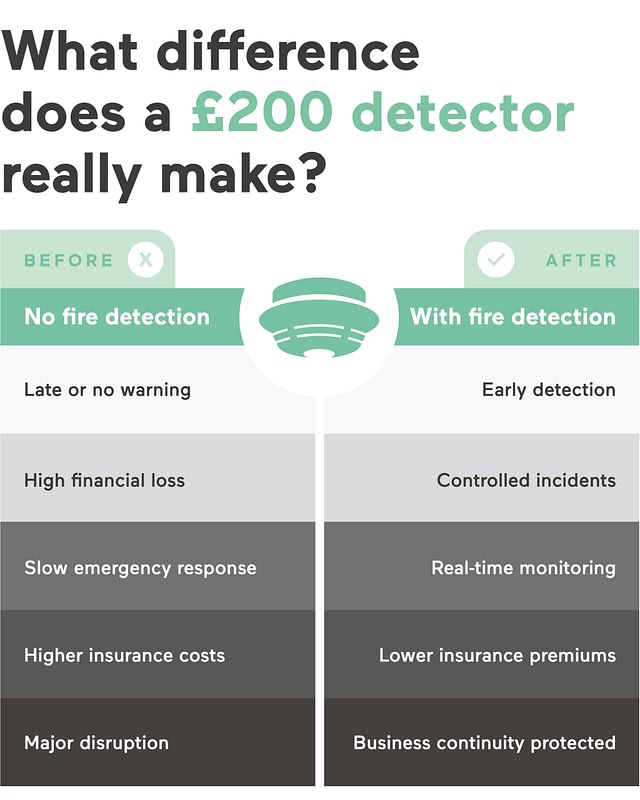
Did you know that early detection of fire can reduce potential damage by 90%? That’s the difference between losing thousands in assets versus hundreds, and it’s this peace of mind that a £200 smoke detector can bring to your business.
The average commercial building fire in the UK costs £1.4 million in damage, while a quality smoke detector costs just a couple of hundred pounds. Add to that the potential insurance savings that a BAFE fire risk assessment can also bring to the table, and it’s clear that a comprehensive approach to commercial fire safety is non-negotiable.
Key takeaways
- Average commercial fire causes £1.4 million in damage, while detection systems cost under £200 per device
- Early detection reduces fire damage by up to 90% compared to undetected fires
- Modern fire detectors integrate with building management systems for instant emergency response
- BAFE fire risk assessment compliance can reduce insurance premiums by 10-30%
- ROI on fire detection investment typically achieved within first prevented incident
- Professional fire alarm maintenance contract ensures 99.9% system reliability
Table of Contents
Understanding fire detection technology
Commercial fire detection systems rely on two core devices: smoke/heat detectors, fitted throughout your premises to detect the initial physical symptoms of fire, and fire alarm control panels (or FACPs), which receive signals from your heat and smoke detectors, triggering wider alarms and sending alerts directly to emergency services or monitoring partners, for the fastest possible response time.
That’s the basic setup for early fire detection in most commercial premises. Of course, this system can be scaled up depending on the size of your operations, with dozens of detectors fitted in high-risk locations around your premises, ready to alert centralised FACP units.
Modern fire detection technology also means that you can choose from a variety of wired and wireless smoke and heat detectors, depending on the exact needs of your business. Naturally, different solutions and setups may push your system above the quoted £200 mark, but given the damage that fires can cause, any system is always worth the investment.
Modern detection features: How technology can help protect your assets
Modern fire detection and alarm systems feature more than just detectors, sounders, alarms, and FACPs. These systems incorporate innovative technologies to boost overall effectiveness – here are a few examples of the kinds of features that you may encounter on modern fire safety solutions.
- Remote monitoring and smart alerts: Modern FACPs incorporate several SMART capabilities, including remote monitoring. Should your detectors trigger an alert, you can receive these directly on your smartphone, for maximum oversight even if you’re away from site.
- AI-powered false alarm reduction technology: Regular false alarms can not only cause disruption, but they can also instill a dangerous sense of complacency. Fire safety experts are leveraging AI to help reduce false alarm frequency, so you always know when an alert is the real deal.
- Fully bespoke fire detection systems: There’s rarely a one-size-fits-all solution to fire safety, which is why modern systems are usually 100% bespoke to your premises. A combination of detectors, sounders, and FACPs may be deployed across your building, ensuring maximum adaptation to different risks and environmental factors.
The true cost of commercial fires
It’s estimated that commercial fires cause over £2.2 billion worth of damage every year to UK businesses. That accounts for both direct and indirect fire-related costs; direct costs include physical damage to on-site assets and resources, while indirect costs are a catch-all for business interruption, potential liability claims, and insurance-related expenses.
Of course, the cost of a commercial fire can be significantly reduced through early detection and comprehensive monitoring. When a fire is detected instantly, this could save your business thousands in direct and indirect costs; you may even receive a reduced insurance premium if you can demonstrate the efficacy of your fire detection infrastructure.
Let’s take a closer look at the direct and indirect consequences of fire in a commercial building, so you can see where costs, losses, and unexpected overheads can quickly mount up.
Cost type | Examples | Why early detection matters |
Direct property damage | Building fabric, contents, stock, equipment | Detection helps contain fire before spread |
Business interruption | Closures, lost bookings, halted production | Faster response reduces downtime |
Liability | Injury claims, legal action, customer impact | Alarms and evacuation protect people |
Compliance and enforcement | Notices, fines, prosecution | Maintained systems support legal defence |
Insurance impact | Higher premiums, claim disputes, exclusions | Documentation improves insurer confidence |
Reputation | Lost trust, media scrutiny, customer churn | Prevention protects long-term value |
Industry-specific fire risks
While every business is vulnerable to fire, it’s worth looking at some examples of how fire can impact organisations differently. That way, you can get a sense of the unique challenges and prospective costs that businesses are exposed to, and the critical importance of early fire detection and prevention.
- Hotels and hospitality venues: It’s estimated that a building fire in a hotel or hospitality venue costs an average of £850,000 worth of direct and indirect damage per incident. That may be as a result of direct damage to the building itself, but will most likely stem from business interruption, loss of bookings, customer impact, and legal action.
- Care homes: Care homes are particularly vulnerable to fire-related costs, since fire safety is wrapped up in their overall compliance and H&S guidelines. Regulatory fines coupled with the direct cost of on-site fire damage can cripple a facility’s finances, not to mention reputational damage and ongoing liability claims.
- Manufacturing facilities: Not only are manufacturing plants and factories at a higher risk of fire due to the equipment and machinery they contain, but costs can spiral when you factor in business interruption and the replacement of critical equipment. Indeed, severe fires can impact the supply chain more generally, so there may be wider repercussions for the sector.
- Universities and research institutions: The outbreak of fire in a university or similar institute can be devastating for all stakeholders, resulting in irreplaceable research and equipment losses. This shows the true cost of commercial fire, beyond pounds and pence.
ROI calculation: £200 investment vs £200 million protection
We started our guide to the cost of commercial fire by suggesting that a £200 investment in fire detection technology could potentially lead to up to £200 million in protection for you and your business. So, how do the numbers stack up?
Let’s take a look at the cost-benefit analysis of commercial fire safety equipment, so you can get a gauge on how much an advanced fire detection and alarm system is likely to cost.
Scenario | Approximate cost | Potential value protected |
One commercial detector | £100–£200 per point | A room, zone or critical risk area |
500 detectors across a large estate | Around £100,000 at £200 each | Large multi-building or high-value site |
Annual maintenance for smaller systems | Often £180–£280+ per year | Legal readiness and system reliability |
Larger or more complex maintenance contracts | £500–£1,500+ per year, often more for high-risk sites | Reduced downtime, fewer failures, better records |
Prevented major fire | One incident avoided | Tens or hundreds of millions in assets, operations and reputation |
The long and short of this chart is that even the prevention of a single major fire on your premises is enough to justify the ROI of your commercial fire safety equipment. Fire alarms, sounders, and advanced FACP technologies pay for themselves by preventing the outbreak of one fire, so any investment you make is a sound one.
Regulatory compliance and insurance benefits
Of course, other potential long-term savings can stem from investing in advanced fire safety technologies. You might, for example, see a significant reduction in your overall insurance premium, so this alone could cover the cost of your initial investment.
Meanwhile, efficient fire safety equipment can also help you to maintain full compliance, safeguarding you against liability or prosecution should the worst happen. A BAFE risk assessment is the best way to ensure that your business is compliant, while also allowing you to identify any gaps in your fire safety system.
Choosing the right fire risk assessment company
Given the significant savings and guaranteed ROI of a modern fire detection system, you might be ready to update your current setup. Of course, that isn’t a case of opting for any old off-the-shelf solution; you need to partner with a trusted supplier of fire safety equipment and services, and one with all the right accreditations and experience.
At JLA, we provide a full scope of fire safety equipment, services, and solutions, from BAFE-certified risk assessments to the installation and maintenance of advanced fire detection and prevention technologies. Partner with us and you’ll benefit from:
- BAFE competence
- Clear cost explanation
- Detection and maintenance expertise
- Fire door capability
- Digital records and reporting
- Support at scale
- JLA’s comprehensive fire safety expertise
- Ongoing fire alarm maintenance contract importance
- Digital monitoring through JLA Connect platform
FAQs
What is the average fire risk assessment cost for commercial buildings?
It’s tricky to put a ballpark on the average cost of a fire risk assessment, since this will depend on the size of your premises and the complexity of your existing fire safety system.
For instance, for a small office or shop with only a couple of detectors in place, a risk assessment should cost around £250-£350, while for a large manufacturing plant, a highly complex, multi-day assessment will likely cost £2,500+
How often should fire alarm maintenance contracts include inspections?
Always. A solid fire alarm maintenance contract should incorporate inspections in line with current regulations. A professional inspection is generally advised every six months, with regular inspections by responsible persons happening every week.
What qualifications should a fire risk assessment company have?
There are several accreditations to look for when choosing a fire risk assessment company, including:
- BAFE Fire Safety Register
- FIA (Fire Industry Association)
- Constructionline
- BM Trada
- CHAS (Contractors Health and Safety Assessment Scheme)
- Smoke Control Association
- IFC (International Fire Consultants)
Can a £200 detector really prevent million-pound losses?
Yes, absolutely. While a single detector is only suitable for small business premises, that doesn’t mean that it can’t help prevent significant financial losses. For instance, while the cost of damage may not equate to millions in company losses, liability claims or non-compliance penalties might.
What's included in a comprehensive fire door inspection service?
Fire doors are a critical component within a broader fire safety system, and are generally inspected as a standalone solution at regular intervals. An accredited inspector will check every part of your fire door’s assembly, from the integrity of the leaf to the overall condition of the seals, hardware, and glazing.
How does BAFE fire risk assessment differ from standard assessments?
A BAFE fire risk assessment is considered the gold standard in fire safety inspections. Why? Because it’s carried out by a BAFE-certified engineer, a person who has been certified competent under the BAFE SP205 scheme.

Mark Bone
Operations Director Mark joined JLA in 2019 and now manages the delivery of turnkey fire safety and security systems designed to protect people, premises and critical assets.
Drawing on his extensive technical, commercial and customer service experience, Mark helps clients with everything from system selection and project planning to ongoing maintenance, ensuring they can navigate complex operating challenges.
In a shifting regulatory landscape, Mark also provides a wealth of safety-first guidance, with a particular focus on reducing risk and strengthening compliance across every site.
Do you want guaranteed ROI from your commercial fire safety equipment? JLA has you covered. Not only do we provide watertight accreditation and compliance, but solutions like Total Care from JLA can mitigate the upfront cost of acquiring new fire safety systems and devices, too. To get started, reach out to our team today on 0808 239 7578.