
Beyond obvious pressures like breakdowns and expensive repair costs, professional kitchens face any number of challenges from outdated catering equipment. Compliance issues, food safety risks, and a general drop in productivity can all create problems that your business could do without.
Here, we’re exploring both the obvious and the unforeseen challenges that can stem from outdated commercial kitchen equipment. We’ll look at the problems that can arise when your catering equipment begins to show signs of wear and tear, and examine why investing in new equipment is always the best option from a professional catering standpoint.
Key takeaways
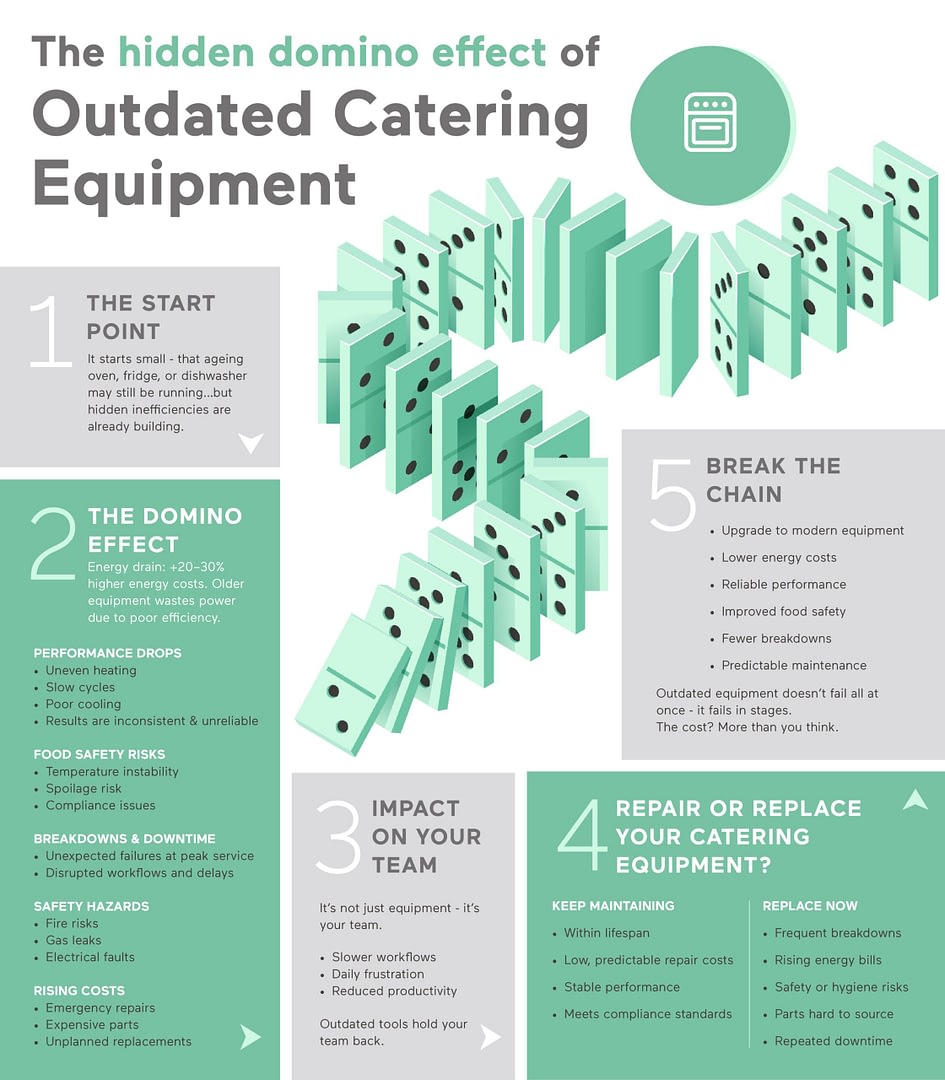
- Energy costs increase by 20-30% with outdated commercial catering equipment due to inefficient heating and cooling systems.
- Temperature control failures in ageing refrigeration units pose serious food safety risks, along with regulatory compliance issues.
- Equipment breakdowns during peak service hours disrupt operations and frustrate kitchen staff, and may impact long-term productivity and diner experience.
- Outdated electrical systems and worn components create fire hazards and safety risks in commercial kitchens.
- Poor equipment reliability reduces kitchen productivity and increases emergency repair costs.
- Modern catering equipment maintenance contracts, like JLA Total Care, eliminate most challenges associated with outdated equipment.
Table of Contents
Rising energy costs and inefficiency
Given the immense pressures that catering and hospitality businesses face, any unnecessary overheads and inefficiencies are unsustainable in the long term. Thus, if outdated catering equipment is driving inefficiencies in your commercial kitchen, this could be contributing to soaring operating costs and a reduced profit margin.
The energy-related cost impact of outdated catering equipment
Did you know that old and outdated catering equipment consumes 20-30% more energy than modern alternatives? That’s a startling statistic, particularly if you multiply this across several different appliances, be it commercial ovens, fridges, or dishwashers.
By upgrading to new commercial kitchen equipment, you can offset these energy-related inefficiencies, actively helping to bring down your day-to-day operating costs. In cases where heavily outdated equipment is relied on, switching to modern alternatives could pay for itself in the long term when energy savings are taken into account.
Inefficiencies and performance issues
Of course, higher energy costs aren’t the only negative at play here. Inefficiencies and performance issues can proliferate where old and outdated equipment is concerned, impacting results, productivity, and day-to-day workflows as a result.
Here’s a chart detailing some of the common inefficiencies and performance setbacks caused by outdated catering equipment.
Equipment type | Common outdated equipment issue | Likely impact | Modern equipment advantage |
Uneven heating, poor insulation, malfunctioning thermostats | Longer cook times and wasted gas or electricity | Better heat retention and more accurate controls | |
Blocked condensers, failing door seals, refrigerant leaks | Higher compressor load and food safety risk | Efficient cooling, improved airflow and better monitoring | |
Clogged spray arms, faulty heating elements, blocked filters | More water use, slower cycles and sanitation risk | Efficient wash cycles and reliable rinse temperatures | |
Degraded thermostats and poor fryer oil temperature control | Inconsistent food quality and higher energy use | Faster recovery and more stable heating | |
Extraction systems | Dirt buildup and ageing fans | Fire risk and poor ventilation | Safer airflow and easier cleaning routines |
Emergency repair costs
Of course, there’s another dimension to consider with regard to regular equipment breakdown in a commercial kitchen, and that’s the cost of emergency repairs.
If you’re not covered by a professional servicing and maintenance contract and are still reliant on outdated equipment, you’re exposed to major repair costs should the worst happen. Repair bills for faulty equipment often dwarf the comparative cost of preventative maintenance and servicing, particularly if you have modern appliances in place.
Safety hazards and compliance risks
As with specific food safety and hygiene risks, we’re confident that you understand the general safety hazards and compliance issues that can stem from outdated, faulty, and ageing commercial kitchen equipment. That includes everything from increased risk of fire to gas supply and maintenance issues, all of which could prove detrimental to the integrity of your kitchen in the short and long term.
The problem with these types of issues in a busy catering environment is that they can often go unnoticed and unchecked, particularly amidst busy day-to-day service periods. It may even be that your kitchen staff don’t know the signs and symptoms to look out for, so safety issues are overlooked and left to worsen.
The two-fold safety and compliance impact of outdated catering equipment
When outdated catering equipment presents a safety risk, there’s a potential two-fold impact to consider.
First, there’s the very real risk of danger to life, as well as potential damage to your commercial premises. Serious safety hazards like fire, electrical fault, and gas leaks can all stem from faulty and outdated kitchen equipment, putting you, your staff, and your customers at risk.
Second to this, but still ultimately super important for business continuity, is the compliance and regulatory penalties that can come as a result of unchecked safety hazards.
If a routine H&S or food safety inspection discovers a serious safety hazard in your professional catering space, the consequences can be far-reaching, from fines and forced closure to custodial prison sentences in the very worst instances.
Reduced kitchen productivity and staff frustration
Working with outdated kitchen equipment is never fun. The risk of frequent breakdown, coupled with a general lack of functionality and efficiency, can leave staff feeling frustrated and unmotivated. It may even lead to a drip-feed of early resignations, with key personnel feeling too undervalued and overlooked to remain in their posts.
Workflow disruption that can stifle business health and growth
In cases where outdated catering equipment is causing bottlenecks and disrupting day-to-day workflows, this is bad for business. Not only may your staff wind up feeling exasperated by ongoing issues, but this can have a knock-on effect on innovation, invention, and creativity, too, stifling business growth and development in the long term.
By replacing outdated equipment with modern alternatives, you can give your team the tools they need to thrive. Indeed, you should see it as a two-fold investment in both your business and your people, demonstrating that you want them to succeed, innovate, and come up with fresh new ideas to carry the business forward.
Higher maintenance and replacement costs
If your commercial catering equipment has surpassed its recommended and optimal lifespan, you should expect higher maintenance and servicing costs going forward. Not only that, but replacing equipment may cost more than it otherwise would have, particularly when rising costs and inflation are taken into account.
The problem with maintaining ageing catering equipment
Nine times out of ten, when commercial kitchen equipment presents a fault, a replacement part is required to solve the issue. In modern appliances, this is fine, since there’s a widespread proliferation of affordable replacements available. But in outdated equipment? Well, things aren’t always quite so easy.
The reason repairing, maintaining, and servicing outdated catering equipment costs more than modern alternatives is that replacement parts aren’t as easy or affordable to come by. Indeed, in instances where a particular make or model has been discontinued, parts may prove impossible to find, resulting in an untimely full equipment replacement that your business had not planned for in advance.
Outdated catering equipment can cause a variety of maintenance issues
Professional caterers and kitchen staff may be surprised by the range of maintenance and servicing issues that can stem from outdated equipment. Let’s take a closer look at some of the issues that can arise, and the remedial work and costs involved.
Equipment type | Typical ageing issue | Maintenance cost risk | Replacement trigger |
Oven | Uneven heating, damaged heating elements, faulty thermostats | Repeated calibration and element repairs | Poor temperature control or safety risk |
Dishwasher | Clogged spray arms, drain pump faults, heating failures | Sanitation failures and service delays | Cannot achieve reliable cleaning or rinse heat |
Refrigeration unit | Blocked condensers, failing door seals, compressor faults | Spoilage risk and high energy costs | Repeated temperature failures |
Mixer or grinder | Belt and gear wear | Mechanical breakdowns and prep delays | Parts unavailable or unsafe operation |
Extraction system | Dirt buildup, worn fans, clogged filters | Fire risk and poor ventilation | Cannot maintain safe airflow |
When to repair or replace outdated catering equipment
We understand that for many professional caterers, the decision of whether to replace equipment or continue seeking ongoing repairs and maintenance can be exceedingly difficult. And a lot of this has to do with timing; how do you know when is the right time to replace your trusty oven, fridge, or freezer, both while minimising disruption and ensuring optimal cost efficiency?
Of course, this decision does rely on a variety of factors, including the severity of issues and faults that your equipment is presenting. But we can perhaps help make your decision a little simpler thanks to our handy maintain or replace guide down below…
Decision factor | Keep maintaining | Replace or upgrade |
Age | Within expected equipment lifespan | Beyond expected equipment lifespan |
Repair cost | Low, occasional and predictable | Frequent, costly repairs |
Performance | Working properly after servicing | Persistent common failures |
Energy use | Stable and efficient | High or unstable energy consumption |
Compliance | Meets food safety and safety standards | Creates hygiene compliance or safety risk |
Downtime | Minimal and planned | Repeated costly downtime |
FAQs
How long should commercial catering equipment last before replacement?
Typically, commercial catering equipment should offer 15+ years of reliable service, assuming that the recommended servicing schedule is maintained throughout its lifespan. Of course, this will depend on the appliance in question and the frequency of use, but, generally speaking, professional catering equipment is designed and built to last.
What are the warning signs that catering equipment is becoming outdated?
An obvious drop in performance, bad odours, difficulty in day-to-day cleaning, and a lack of replacement parts can all signal that a commercial kitchen appliance is reaching the end of its expected lifespan.
How much can outdated equipment increase energy costs?
Significantly. Unlike their modern counterparts, outdated catering appliances may not have been designed and developed with peak energy efficiency in mind. As such, businesses could face 20-30% higher energy costs than they would from new and modern equivalents.
We hope this comprehensive resource has provided food for thought on your ageing and outdated commercial catering equipment. If you feel it’s time for an upgrade, Total Care from JLA could be the ultimate solution to give your professional kitchen a much-needed revamp. Contact our catering experts today on 0808 239 7578 to find out more.