
While commercial laundry equipment is built to exacting standards and will generally last much longer than domestic equivalents, a consistent maintenance schedule is key to extending its lifespan.
Join us for expert practical guidance on how to correctly maintain, service, and safeguard your on-site laundry equipment. We’ve compiled a checklist of need-to-know tips that you can use to keep your washers and dryers working at their best for longer – saving your business money while maintaining peak levels of efficiency and performance.
Daily cleaning and maintenance
Interval: Daily
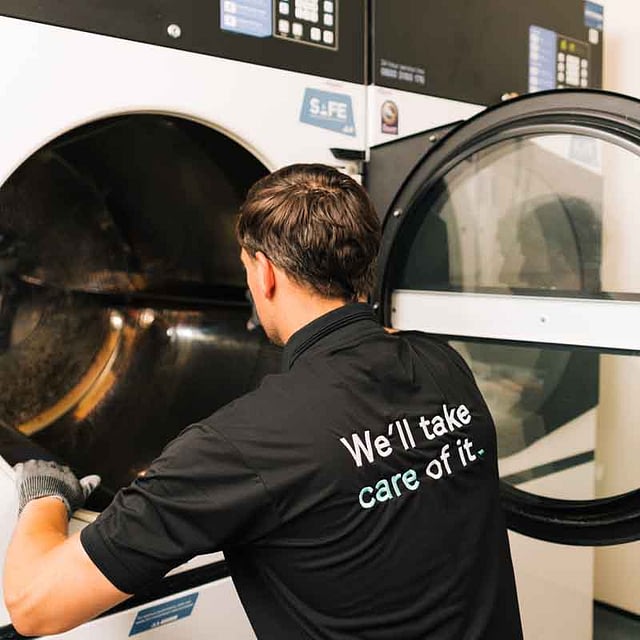
We understand that it’s easy to forget about daily equipment cleaning and maintenance. With a business to run and a stack of laundry to process, ensuring that machines are clean and in good working order may be the last thing on your mind.
However, neglecting to clean and maintain equipment on a daily basis is where problems can start. If you’re not paying attention, you might miss uncleanliness, build-up, and the odd vibration/noise here and there that can spell trouble for your equipment in the long term.
As such, each day, remember to:
- Wipe down surfaces and visually inspect each appliance
- Remove dirt, debris, and lint
- Check the seals, door, coin facility, and detergent compartment
Filter cleaning and maintenance
Interval: Weekly
Every laundry professional knows that the condition of a machine’s filter is of the utmost importance. The minute a filter becomes blocked, that’s when you’ll see a drop in efficiency and problems start to develop; of course, there’s also the safety risk associated with a blocked lint filter to consider, too.
With that in mind, we recommend doing the following on a weekly basis:
- Remove and clean the lint trap
- Check other filters and clean if necessary
- Look for blockages in the pipes, vents, and ducting
Have your commercial laundry equipment professionally serviced
Interval: Twice a year
Ideally, your on-site commercial laundry equipment should be serviced bi-annually, or in line with the manufacturer’s servicing schedule. Of course, this will also depend on usage and volume, with some equipment requiring more regular servicing.
Commercial laundry equipment servicing should be carried out by a qualified technician. They will safely dismantle each appliance to check core elements like:
- Internal belts and hoses
- The condition of the drum and cylinder
- Wiring and other connections
- Vent lines and ductwork
Of course, if you procure commercial laundry equipment from JLA, professional servicing and maintenance may come as standard. For example, our commercial laundry service contracts are perfect a standalone maintenance solution, while Total Care from JLA offers a complete procurements and maintenance plan for all your equipment needs.
Training and safe usage
Interval: Ongoing
One of the simplest and most effective ways to ensure that your commercial laundry equipment remains in a clean bill of health is to educate staff on efficient daily usage, along with your maintenance and cleaning expectations.
Generally speaking, “efficient daily usage” could be defined as:
- Avoiding overloading the machine – weight limits must be followed
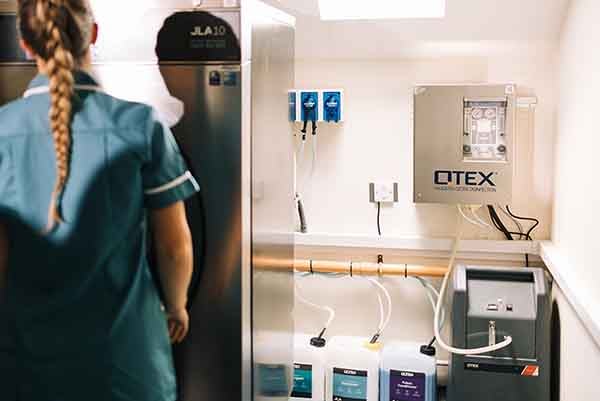
- Using the correct detergents and cleaners, while also ensuring accurate dosing – an auto-dosing laundry dispenser can help with this
- Choosing suitable wash/dry cycles to protect garments and linens and ensure that the equipment is used as intended
Along with these basic staff training requirements, it’s also worth reiterating the importance of day-to-day cleaning and maintenance. Make sure that your staff are aware of the tell-tale signs that a fault is developing, too. For example:
- Understanding fault warnings and alerts on the appliance interface
- A blocked lint trap or filter
- Longer-than-expected drying times
- Water pooling in the washer when the cycle is complete
Miscellaneous tips for extending the life of your commercial laundry
There are 100 and one ways that a commercial laundry appliance can go wrong, and you’d be surprised by the variety of faults and issues that our network of engineers attend to on a daily basis. This has given us unique insight into the potential issues that can arise, so here are some additional maintenance tips and advice to consider…
- Make sure your appliance’s onboard firmware is up to date: If you have a SMART washing machine or dryer with a digital interface, make sure that the system’s firmware is kept up to date; otherwise, a fault may develop.
- Lubricate internal components regularly: A lack of lubrication is a critical issue for laundry equipment, and is something that’s easy to overlook. Of course, parts will be lubricated as part of regular servicing, but it’s an easy maintenance task that you can carry out yourself, too.
- Always use the correct detergent at the right volume: Some detergents are specifically developed for certain appliances, so it’s important to use the manufacturer’s recommended products at all times to safeguard the long-term health of your equipment.
- Check the water hardness in your area: If your laundry is based in a hard-water area, your equipment may require more regular maintenance and servicing due to the risk of scale and calcium deposits.
- Manually check cycle time and temperature: If you suspect a fault with your commercial washing machine or tumble dryer, this may have affected cycle time and operating temperature. Devise a way to check both manually, so that you can guarantee accurate cycle time and a hygiene-boosting temperature.
So, there you have it, our essential tips and guidance on how to prolong the life of your commercial laundry equipment. Should you need to update your current equipment or you would like to arrange professional servicing, contact us today and we’ll be happy to help.
Similar blogs you may like
Is used or refurbished commercial laundry equipment worth it?