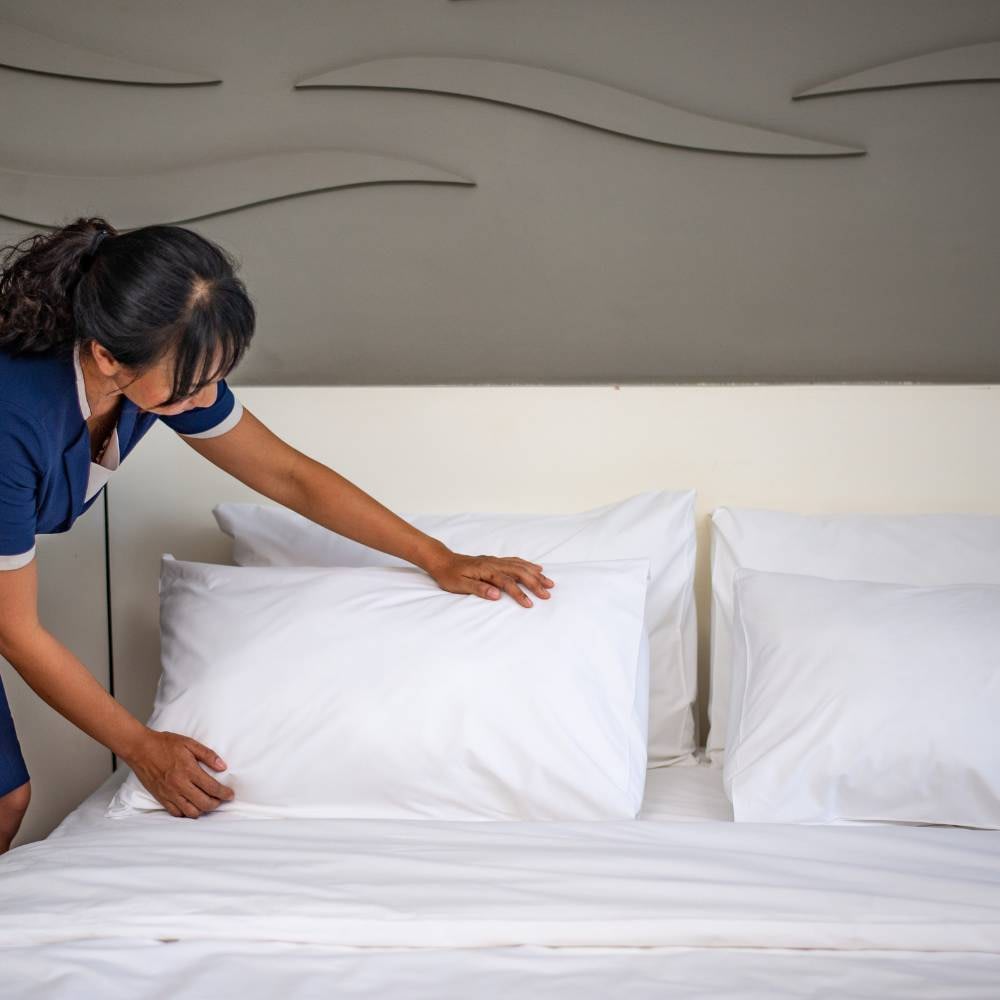
Of all the commercial businesses with on-premises laundries, hotels have by far the most demanding and resource-intensive requirements. Processing hundreds of bed linens, towels, and flatwork every day is no mean feat, so a slick, well-managed workflow, along with reliable equipment, is essential to achieving peak performance and efficiency.
Here, we’re taking a look behind the curtain at hotel laundry operations, lifting the lid on what exactly goes into keeping clean linens flowing from room to room. Ideal for laundry professionals and prospective hoteliers alike, this resource offers a top-down look at the hotel laundry process in full, so you can see what’s required, the problems that can arise, and the hard-working equipment that keeps things ticking along behind the scenes.
What are hotel laundry operations?
Never has the term “like a well-oiled machine” been truer than in the context of hotel laundry operations. Every element of a hotel’s laundry process must be streamlined and efficient, with any weak link liable to cause a huge headache for managerial, backroom, and housekeeping personnel.
Of course, a hotel’s laundry operations encompass several different core areas. First, and perhaps most important, is linen, towel and flatwork processing, which is critical in maintaining a solid guest experience – not to mention a streamlined workflow for housekeeping staff responsible for daily turnovers.
Laundering hundreds of bedsheets and towels on a near-daily basis requires significant oversight and a reliable collect-wash-dry-redistribute workflow. That’s especially true for hotels in high-demand areas, when regular spikes in customers can put additional strain on on-premises laundry operations.
Next, hotels offering guest laundry services require a wholly different approach, with standalone laundry equipment in place to handle guest-facing services like washing, drying and garment pressing. In some instances, it may even be necessary to hire staff to handle this portion of your laundry workflow, although this is only really required in large hotels expected to have a large throughput of laundering requests from their guests.
Given the multi-faceted nature of hotel laundry operations, it’s easy to see why careful management and efficient workflows are critical in delivering reliable, cost-effective laundering that is sustainable and aligns with your overall guest experience.
The end-to-end hotel laundry process explained
From collection to redistribution, pre-treatment to finishing, hotel laundry operations are cyclic and phased, requiring careful management at every stage to maintain optimal efficiency. Here, we’re taking a look at the hotel laundry process in full, so you can get a sense for the various steps involved.
Collection and linen segregation
Collecting linens, towels, and flatwork from individual hotel rooms might sound like a simple process. But it requires careful management to uphold cleanliness and hygiene while ensuring that items can be sorted and categorised with ease.
Stripping a room of used linens and towels is only the start of the collection process. Housekeeping personnel must abide by strict laundry segregation protocols to ensure no cross-contamination between used and fresh linens, with pre-defined routes in place to transport ready-to-launder items through the hotel quickly and efficiently.
Sorting and pre-treatment
When linens, flatwork and towels reach the laundry room, they must be sorted by fabric type, while also being checked for stains and heavy soiling. Any stubborn marks may require pretreatment with a suitable stain-removing detergent before items are processed as part of the standard wash cycle.
Typically, in large-scale hotels, soiled linens are weighed on an industrial bench laundry scale to ensure correct loading. Pre-weighing laundry loads ensures optimal wash cycles, with each commercial washing machine filled with the correct load for its weight capacity.
Washing cycles and chemical dosing
With linens added to the washing machine by weight, the next phase of the process involves dosing the machine with an adequate ratio of detergent. The chemicals and detergents used must be compatible with the type of laundry (towels and linens may require different formulations), with accurate dosing required to achieve reliable results while maintaining peak efficiency.
Typically, large hotels with significant laundry requirements use autodosing technology to ensure that their washers are pre-loaded with the correct quantities of detergents and softeners. These systems dose by weight and fabric type, reducing instances of waste while ensuring professional results wash after wash.
Extraction and commercial drying
It goes without saying that hotels require fast turnaround times from their commercial laundries. As such, efficient moisture extraction and drying are key to maintaining reliable processing speeds, so your flatwork, linens, and towels can be finished and redistributed without delay.
Often, hotels rely on industrial-grade tumble dryers to deliver consistent laundry drying times and peak energy efficiency. Such appliances feature high G-force extraction and in-built moisture sensors, so no cycle is longer than it needs to be – for the best combination of speed and energy efficiency.
Finishing, folding, and quality control
Appearances matter in hotels, which is why laundry finishing, folding, and quality control are of the essence in laundry workflows. Of course, achieving peak results at scale is no easy feat, which is why hotels rely on dedicated laundry finishing technologies to maintain great results without compromising on speed and efficiency.
Commercial irons provide the best means of finishing hotel linens, towels, and flatwork to a high standard. Large-scale hotels often use rotary or roller irons to remove creases from large flatworks in seconds; some appliances even feature in-built folding technology, making the finishing process even faster.
Storage and redistribution
The hotel laundry process culminates in the redistribution or storage of clean, finished linens and towels. It’s vitally important that clean, fresh laundry is kept separate from used and contaminated items, with separate zones and storage areas to ensure no chance of cross-contamination.
When redistributing fresh linens and flatwork, housekeeping personnel should abide by “clean” and “used” laundry routes through the premises, which helps to prevent crossover. Often, per-floor storage areas are used so that clean linens have minimal distance to cover before they’re added to a room ahead of new guest check-in.
How much laundry does a hotel process?
Whether you’re an experienced laundry room manager or a prospective hotelier looking to open your first boutique guest accommodation venture, it can be useful to know how much laundry the average hotel processes per day. After all, this is essential in helping you retrofit your on-premises laundry with the correct equipment, while also guaranteeing the appropriate staffing levels.
Of course, several factors can affect how much laundry your hotel has to process, including:
- Number of rooms
- Peak occupancy level
- Average occupancy level (factoring in weekday vs weekend, plus holiday periods)
- Per-room occupancy (single rooms require less laundering than multi-occupancy suites)
- Check-in and check-out times
- Accommodation rating
Taking into account these factors, typical hotel laundry processing can equate to the following:
| Hotel type | No. of rooms | Occupancy | Occupied rooms | Avg. per room (kg) | Total laundry (kg/day) |
|---|---|---|---|---|---|
| Small budget | 50 | 60% | 30 | 5kg | 150kg |
| 75% | 38 | 5kg | 190kg | ||
| 90% | 45 | 5kg | 225kg | ||
| Mid-scale | 100 | 60% | 60 | 7kg | 420kg |
| 75% | 75 | 7kg | 525kg | ||
| 90% | 90 | 7kg | 640kg | ||
| Large hotel | 200 | 60% | 120 | 8kg | 960kg |
| 75% | 150 | 8kg | 1,200kg | ||
| 90% | 180 | 8kg | 1,440kg | ||
| Luxury hotel | 300 | 60% | 180 | 10kg | 1,800kg |
| 75% | 225 | 10kg | 2,250kg | ||
| 90% | 270 | 10kg | 2,700kg |
The equipment used in hotel laundry rooms
The question of which equipment might be found in a hotel laundry room might sound easy to answer. However, it’s worth reviewing the specific requirements and capabilities associated with hotel laundry equipment, particularly if you’re seeking to upgrade your on-premises laundry.
Washing machines
Even for boutique hotels with a handful of rooms, a commercial washing machine can make light work of daily linen, towel and flatwork cleaning. Commercial washers come in a variety of capacities and weight options, catering to hotels, big or small.
Of course, capacity isn’t everything when investing in a commercial washer for a hotel business. You need to consider additional features like spin speed, auto-dosing, and water extraction, all of which can significantly improve your day-to-day laundry workflows while expediting cycle times.
Dryers
Drying linens, towels and flatwork quickly is par for the course in a hotel environment where rapid laundry turnover rates are paramount. Commercial tumble dryers offer super-fast laundry drying times, with G-force-rated moisture extraction and large door openings to accommodate large loads with ease.
In some scenarios, it may be more efficient and space-saving to stack a tumble dryer on top of a washer, freeing up space while ensuring a fast and intuitive laundry workflow. Note, too, that some professional tumble dryers also feature “smart” features like automatic “dry” detection, which can help to make your laundry room even more efficient.
Finishing equipment
Whether it’s industrial rotary irons for large flatwork or hand irons for handling guest laundry on the fly, hotels require efficient finishing equipment to maintain high standards of service. Commercial finishing equipment is developed with such establishments in mind, providing ease of use, reliability, and consistent performance.
Professional ironing systems not only help you to remove creases from large and unwieldy flatwork, linens, and towels, but some models also feature extra functions like automatic folding and variable temperature control. This makes them a versatile addition to your on-premises laundry, perfect for day-to-day laundry processing as well as ad-hoc garment finishing for guests.
On-premise laundry (OPL) vs outsourced laundry: Which is best for hotels?
In some instances, a hotel or guesthouse may not have the space, infrastructure, or resources to handle laundry operations in-house. It may even be cheaper and more efficient to outsource laundry processing to a third-party, at least in the short term.
With that in mind, let’s take a closer look at the pros and cons of both on-premises hotel laundries vs their outsourced counterparts, so you can make an informed decision that’s right for your business.
On-premises laundry
For large hotels with a designated laundry room, on-premises laundering is by far the best, cheapest, and most efficient option. Even in instances where you need to invest in a suite of new laundry equipment, the long-term savings far outweigh any upfront equipment procurement costs you’re faced with.
The core benefits of on-premises laundry concern control, ease of management, and efficiency. You’re in control of every element of your laundry workflow and pipeline, leaving no question marks over the timings and stages of your laundry cycle.
Outsourced laundry
For boutique hotels, guesthouses, and B&Bs, outsourcing your laundry to a managed laundry service may be a more flexible and appropriate solution. This is particularly true in instances where you have neither the space nor the infrastructure to set up a reliable and safe laundry room on your site.
In this scenario, you’ll usually set up a contract with a third-party laundry specialist, who will then collect, process, and return your items at an agreed time. Of course, the more linen, flatwork, and towels you require processing, and the faster you need them returned, the more you can expect to pay for this kind of service.
Hybrid models
In some situations, small-to-medium-sized hotels may find that a hybrid approach (incorporating both OPL and outsourced) works best for their laundry processing needs. In this scenario, you might outsource the processing of linens, towels, and flatwork to a third party, while covering guest laundry (including washing/drying clothes or finishing garments) services in-house.
What common problems can arise in hotel laundry rooms?
Recognising the common issues, bottlenecks, and inefficiencies that can arise in a hotel laundry room is essential in reducing downtime and maintaining optimal laundry throughput. With that in mind, let’s take a look at some of the most prevalent problems that can materialise in commercial hotel laundry suites, with some tips on how to solve and prevent them.
Equipment downtime
The problem: If your washer, dryer, or finishing equipment fails, this can throw your laundry workflow into disarray, leading to significant bottlenecks and housekeeping delays.
The solution: Ensure you’re covered with a commercial laundry servicing and maintenance contract, including the provision of rapid emergency callout times, day or night.
Inexperienced staff
The problem: Your staff aren’t up to speed on how to use your laundry equipment efficiently, or else have misgivings about your overall housekeeping and laundry workflow. This can affect service levels and delivery times, and may even lead to equipment failure.
The solution: Provide regular training and supervision for all staff members, ensuring that all stakeholders are up to speed with your laundry processing workflow.
Overreliance on manual processing
The problem: Hamstrung by ageing laundry equipment, your staff rely on manual processing at key phases in your laundry workflow, such as finishing and folding. This creates bottlenecks and inefficiencies that can stymie service levels and create more unnecessary work for key personnel.
The solution: Ensure that your on-premises laundry is provisioned with up-to-date equipment that brings genuine performance and efficiency-enhancing benefits. For example, trading in hand finishing equipment for a commercial rotary iron can significantly reduce manual processing.
We hope this resource has provided some inspiration and food for thought on how to improve the efficiency and performance of your on-premises commercial hotel laundry suite. If you require additional guidance and support on how to upgrade your laundry room, the experts at JLA are here to help. Get in touch or call us on 0808 239 7578.
Similar articles you may like
A swift laundry upgrade for IHG Holiday Inn and Staybridge Suites